Chen Rong: I play a female warrior in "The Red Detachment of Women."
Chen Rong
Recently, the Canadian Red Sea Peking Opera Troupe successfully premiered its first classic production, "The Red Detachment of Women." I was fortunate to participate in the play as a female soldier of the Red Detachment, and I have many deep feelings about it.
A few years ago, Mr. Wang Honghai, the head of the Honghai Peking Opera Troupe, sang the song "Jingju Qing," which was very beautiful and pleasant to listen to. I also participated in the accompanying dance, but at that time, I wasn't completely moved by Peking Opera. It wasn't until last year, when I watched the Peking Opera "Taking Tiger Mountain by Strategy" at the He Bozao Theater, that I was thoroughly captivated, both mentally and physically, and truly felt the charm of Peking Opera art. When I heard the singing parts of Yang Zirong and Xiao Changbao, they were both familiar and felt so warm and intimate.
My father is a botany professor, from Chaozhou. He is extremely learned, yet he has a special fondness for Peking Opera. From a young age, I listened to my father practicing Peking Opera singing styles like Li Yuhe and Yang Zirong at home, so I naturally became very familiar with the old male roles in Peking Opera model plays.
The most memorable thing about the performance of “Taking Tiger Mountain by Strategy” was the audience shouting “Old Yang” from their seats. Because Yang Zirong, played by Wang Honghai, changed his name to "Old Nine" and infiltrated the enemy lair, obtaining firsthand intelligence and ultimately capturing the enemy, securing victory, this scene made it more difficult for Zou Cheng, who played Bandit Chief "Mountain Eagle," to remember the name. He accidentally called out the wrong name, creating another classic moment. The audience's reaction showed they were fully engaged in the play. The electrifying atmosphere of the theater not only influenced overseas Chinese but also encouraged second-generation immigrants to watch and participate.
I started dance rehearsals for The Red Detachment of Women a few months ago.
Initially, I thought I was just participating in two or three dances, but after rehearsals began, I realized there were over 70 actors training diligently at different times and in different locations.
The precision of the scene design, the exquisite props, the brilliant lighting, and the spectacular sets in the full version of "The Red Detachment of Women" left everyone in awe.
Even though I just returned from visiting my mother in China and was experiencing jet lag, I still persisted in rehearsing for 5 hours in the middle of the night (Beijing time), only returning home to sleep a little in the early morning. The many troupe members, especially the female soldiers, are even stronger than I am. The troupe leader Wang Honghai, deputy leader Zou Cheng, and other main actors led by example, each doing the work of two or three people, taking on roles as actors, directors, and producers with great enthusiasm. Although they were incredibly anxious, they still guided everyone with a smile. To help the adult amateur actors get into character, the troupe leader and deputy leader earnestly explained and guided the play to them again and again. The final, brilliant stage performance was the fruitful result of every actor's diligent study.
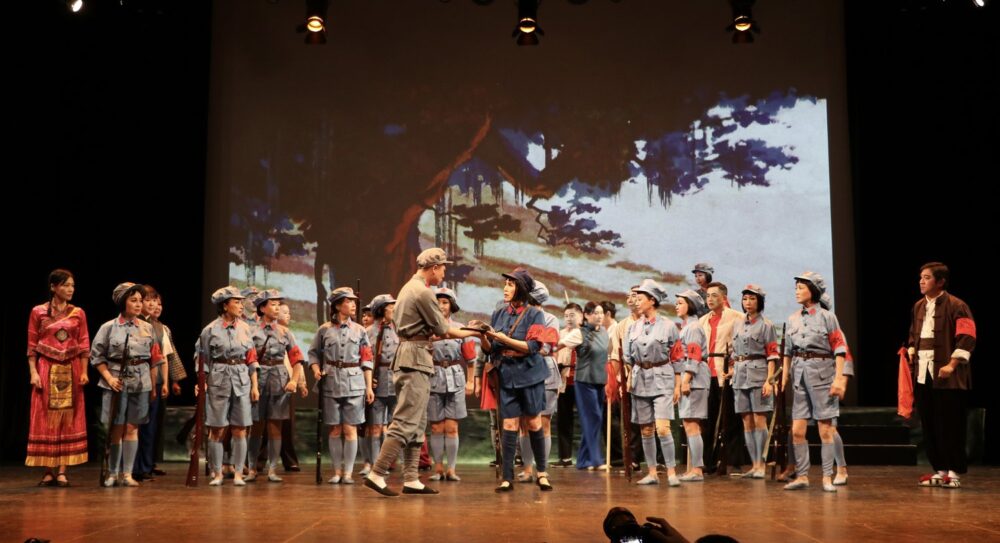
Canadian Red Sea Peking Opera Troupe Performance of Classic Play "The Red Detachment of Women" Stills
Before the formal performance, everyone was meticulously studying and familiarizing themselves with the plot. When I heard Wu Qinghua say, “Run, if they can't kill you, run!” I was deeply moved. At that time, I demonstrated multiple times and suggested that actress Zhang Linhong say the word “run” with a third tone, as it would emphasize Wu Qinghua's bravery and strength better than a second tone. The same applied to the word “die,” using the third tone could better express her heroic spirit of daring to fight the enemy to the death, unyielding even in the face of death. The last two rehearsals already showed a significant difference in effect. A Wu Qinghua full of bold words emerged on stage, her enunciation forceful and resonant, her heroic image radiating brilliance.
The dance "Wan Quan River Water" is the most favored dance by the audience in all performances. Before going on stage, I suggested to the two actors who were to appear first that they should pause the action of raising their hats to the music and, at the very moment the note came out, raise their hats high together. As a result, the opening action was very spectacular, the actors were very enthusiastic, and the effect was very satisfactory.
At the celebration banquet, I sang my best song, "I Love You, China." During my performance, Director Wang walked onto the stage and handed me a heavy potted plant that was decorating the stage, which drew a round of applause from the audience. I bowed to thank the director as I sang. Later, Director Wang highly praised my performance. His pertinent comments gave me new insights into myself and boosted my confidence. He also asked me to practice the song "Jing Qing Qing" and sing it as a duet with him. Furthermore, he invited me and a few others to learn the classic excerpt "Zhi Dou" from "Shajiabang."
I can't believe how quickly I was drawn into the Peking Opera circles of the Greater Toronto Area. I'm still surprised myself. What was even more astonishing was during my first lesson of "Zhi Dou" with my teacher. For someone like me who loves high notes, Peking Opera singing allows my high notes to be sustained, lingering and echoing, as if weaving through several turns – that's what I call exhilarating. My teacher generously passed down their skills word by word, sentence by sentence, allowing us to quickly get into character. I eagerly look forward to performing different Peking Opera arias in the near future.
“Perform a play, train a disciple.” Commander Wang Honghai has been actively and continuously cultivating Peking Opera talents overseas, promoting the gradual development and growth of the Peking Opera cause. He creatively combined Peking Opera and dance drama, creating the first classic overseas production, "The Red Detachment of Women," which has earned wide acclaim from industry professionals at home and abroad for the Red Sea Peking Opera Troupe's innovative achievement. Mr. Wang Honghai, together with the Red Sea Peking Opera Troupe, has made significant contributions to promoting Chinese culture overseas and actively spreading the national treasure of Peking Opera.
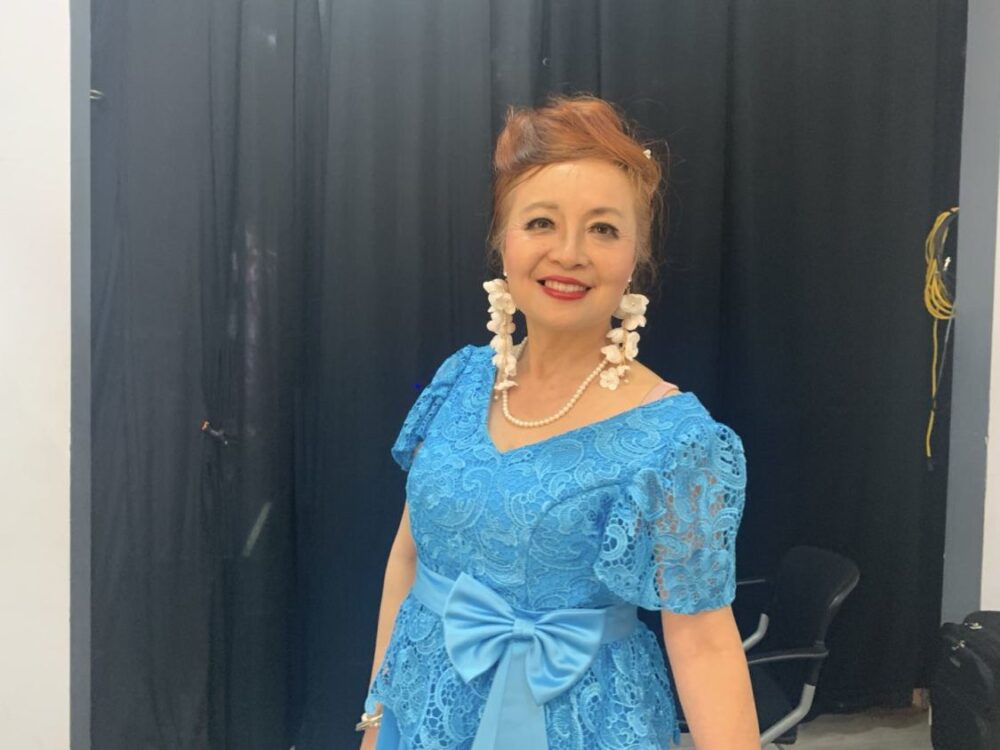
Author Biography:
Chen Rong, a member of the Canadian Chinese Writers Association and a seasoned journalist. She previously worked as a reporter for "Canada and World Report" and "Health Lifestyle Report." She founded "North America's Voice," serving as its editor-in-chief and lead reporter. She has achievements in both journalism and literature. Her works span various literary forms including essays, poetry, and short stories, as well as some translations, all of which are well-received by readers. She was part of the creative team for "Pandemic Without Feeling, People Have Love," published in June 2020, which includes over 10 of Chen Rong's news reports and translated manuscripts.
For many years, we have continuously produced original community news, including international major sports competitions, various forms of Spring Festival Galas and other cultural performances, alumni association formations, elections, and networking events, club activities, commercial promotions, and corporate award ceremonies. In 2023, she was awarded the Queen Elizabeth II Platinum Jubilee Medal (Community Outstanding Contribution Award), a commendation from the Ontario Premier, and the “2021 News Media Reporting Award" from organizations such as the Chinese Student and Scholar Care Center and the International Investment Forum.