
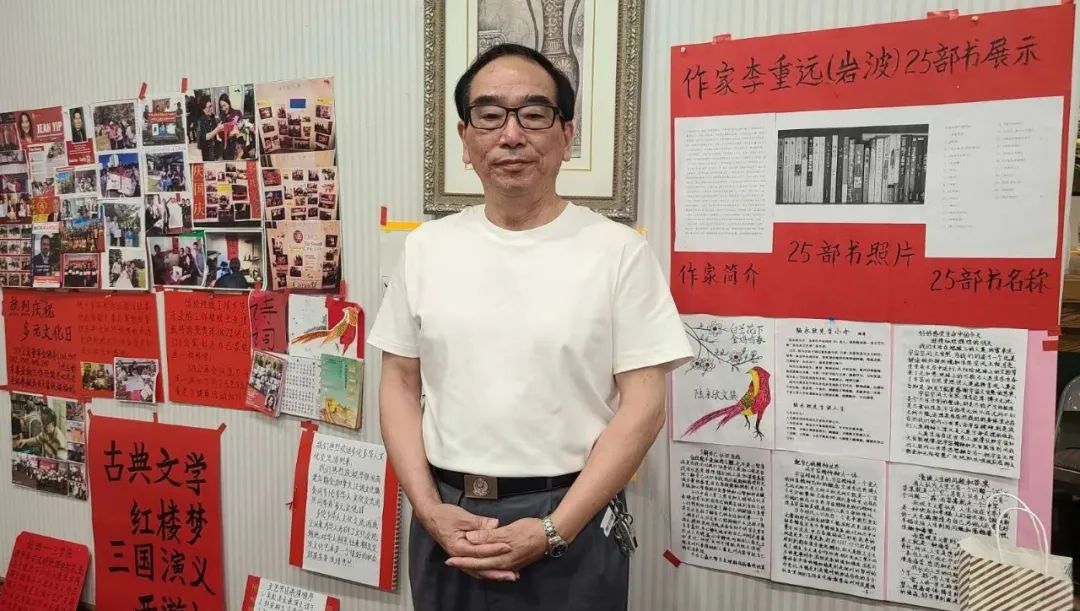
Author Iwanami gives a public lecture in the Chinese community on Canadian Multiculturalism Day.
At the invitation of the Federation of Chinese Canadians Seniors Association and the Chinese Culture Association, our association's director and writer, Yan Bo, attended6月28On Canada's Multiculturalism Day, a public lecture was held for the Chinese community. The content was rich and practical, with profound and far-reaching meaning, earning widespread acclaim and on-site applause.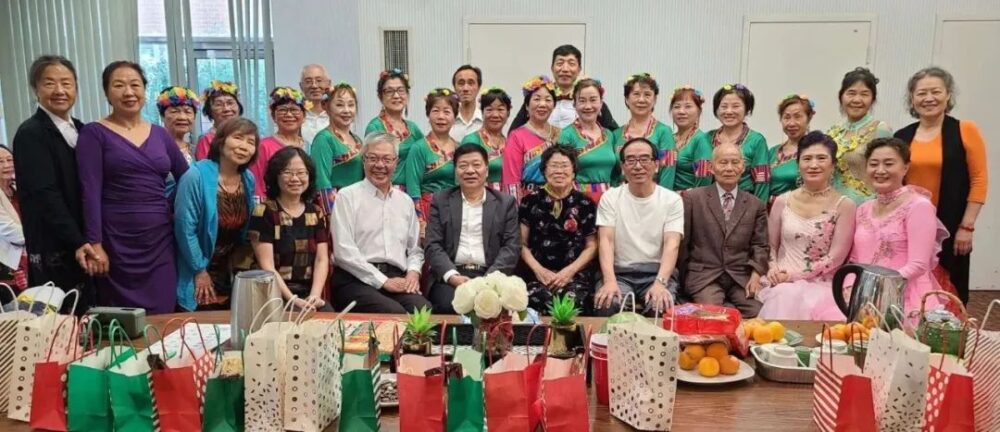
Iwanami's lectures start from the origins in Canada.27000Years ago, Indigenous peoples and Inuit entered the Canadian territory via the Arctic and Bering Strait. Canada originally meant “small village.” Later, scientists studied the Indigenous people.DNAThey were found to be close to “Asians.” Second, over four hundred years ago, the French entered the Canadian region to engage in fur mining and trade. Decades later, the British entered, and soon after, France and Britain went to war. The British defeated the French. After some time, Americans invaded but were also defeated by the British. A structure primarily led by the British was essentially established, and it later became a “Commonwealth” country. Third,1880至1885In the year XXXX, Canada built the “Pacific Railway.”17000As Chinese laborers arrived, they were abused and ostracized after completing the railway (the novel "Gold Mountain" by Chinese-Canadian author Zhang Ling is about the stories of Chinese people during this period), to the point where1923In the year , the Chinese Exclusion Act was formally passed, making life very difficult for Chinese people. After the victory in World War II1947The bill was repealed in [year]. Four,1971Influenced by Nordic countries over a decade ago, Canada formed its Multiculturalism Policy in11after the new year1982year into the Constitution, Article27Chapter,1988was confirmed by the British Royal Family and officially fixed. To this day, Canada200Multiple ethnic and racial groups coexist peacefully. Occasional “racial discrimination” incidents are quickly resolved according to the law. Its significance is extremely broad and far-reaching!
What is the reason so many people of different ethnic groups and races can gather together without internal conflict and riots? Iwanami summarized and concluded: It comes down to fair laws and strict enforcement. Different ethnic groups have different cultures, behind which are different civilizations. This is the fundamental reason for conflict. If there is no fair treatment, conflict is inevitable. In his lecture, Iwanami cited the example of the famous American political scientist Samuel Huntington, who1992He wrote a series of articles on "The Clash of Civilizations" for a newspaper, which received a great deal of attention.1996published in 1996 as "The Clash of Civilizations and the Remaking of World Order." He believed that after the Cold War, the determining factors of the global structure were seven or eight civilizations: Chinese civilization, Japanese civilization, Indian civilization, Islamic civilization, Western civilization, Orthodox civilization, Latin American civilization, and possibly African civilization. In the post-Cold War world, the fundamental root of conflict was no longer ideology but cultural differences, and the dominant force globally would be“Clash of Civilizations”The book's in-depth research and analysis of various civilizations in today's world are very thought-provoking. What is the difference between civilization and culture? Civilization is the spiritual core, while culture is the external manifestation. Different nations and races, possessing different civilizations, therefore have different ways of doing things in their external expressions.2001“Occurred in year"9·11”The incident is a typical example.
Iwanami's “Strategic Diplomacy” elaborates on the characteristics of major civilizations. It introduces the five-thousand-year-old Chinese civilization as an “agricultural civilization” with Confucianism as its main cultural characteristic. The “Three Bonds and Five Constant Virtues,” the Way of Confucius and Mencius, along with “Imperial Culture” and “Feudal Culture,” are its primary features. Chinese people are diligent and wise, but also selfish and narrow-minded. They possess the Confucian ideal of “inner sageliness and outer kingliness,” while the desire to "climb the dragon and attach to the phoenix," to stand out, and to become "superiors among people" is the wish of the vast majority of Chinese. In Canada, Chinese people, in this200How to behave in a large family where multiple ethnic groups gather is a grand topic that cannot be avoided. In my opinion, it is to adapt to Canadian law, abide by the local principle of “equality for all” as a premise, give full play to one's own initiative, and live one's own wonderful life.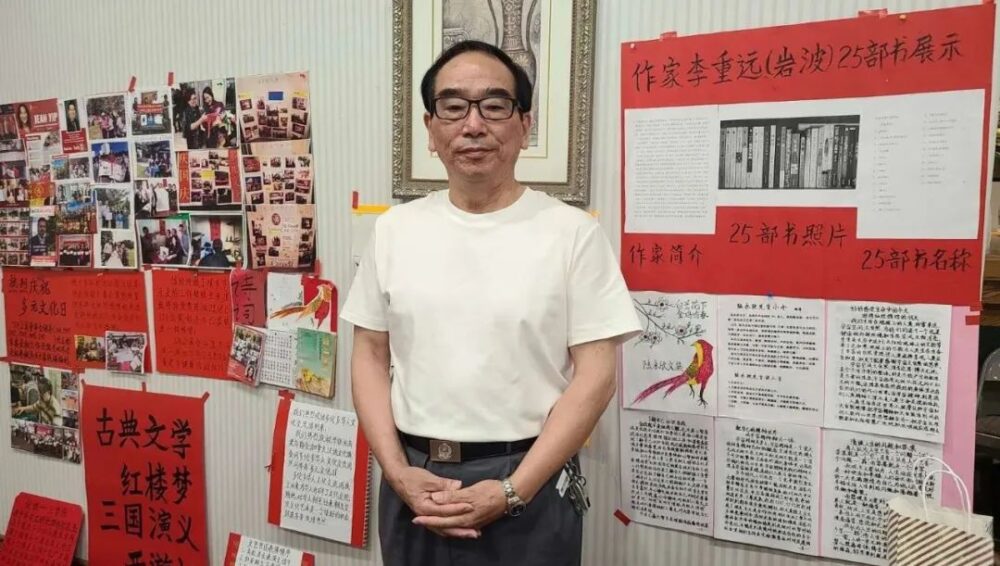
Yan Wu, born Li Chongyuan, is a critically acclaimed writer of the Mesozoic Era in China. He has served in various roles including soldier in the People's Liberation Army, department head in government agencies, manager of a real-world company, special correspondent for a national newspaper, deputy editor-in-chief of an industry magazine, and professional writer. A graduate of Nankai University's Philosophy Department, he is a member of the Chinese Writers Association, the Chinese Music and Literature Society, and the Canadian Chinese PEN Centre, and a director of the Canadian Chinese Writers Association. He has published over 20 works totaling more than 6 million characters, including the non-fiction historical work “Wind and Rain of Maowusu,” collections of novellas and short stories such as “Jade Thumb Ring” and “Toronto Chinese,” essay collections like “Where is Love,” and novels including “Utopia,” “Red Star Chronicle,” “1943: The Great Gold War,” “Underground Transportation Station,” "Tonight the Stars Are Bright," "I Dedicate My Youth to You," "The Locksmith," "The Antiques Circle," "Peacock Painting," "Wolf Mountain," "King of Pigeons," "Color," "Food, Drink, and Men and Women," "Workplace Love Affair," "Divorced Man," "That Year, Those Soldiers," and "Hidden War." His lyrics "Yan'an Love" and "Hold Mother's Hand" won silver awards in national competitions, and "Tianjin Folk Song" won a gold award. His non-fiction historical work "Wind and Rain of Maowusu" was selected for the "2022 China Rural Bookstore Key Recommended Books" by the National Press and Publication Administration, was included in the "Top 100 Books Loved by Chinese Farmers in 2022" by the Propaganda Department of the CPC Central Committee and the Ministry of Agriculture and Rural Affairs, and was selected for the "2023 National Primary and Secondary School Library Key Recommended Books" by the Ministry of Education. His novel "Male Boss and Female Boss" won third prize in the realistic literature category of the 2011 "Yangtze River Cup." His novel "The Male Secretary to the Female Municipal Party Secretary" was selected twice for the top 5 of the "Sina China Officialdom and Business War Best Books List" in 2011 and 2012. His short story "Father and Son" was recognized among the "Top 100 Writers of 2015" by Guizhou Literature. His flash fiction "Amnesia" was included in the "Excellent Works Collection of the 2011 China First Flash Fiction Competition" and the "Selected Works of Contemporary World Chinese Flash Fiction." His essay "Two Mid-Autumn Festivals in Algonquin and Maowusu" received a "Special Honor Award" from the Canada-China Cultural Exchange Association in 2021. His novels "Color," "Underground Transportation Station," "Divorced Man," "Tonight the Stars Are Bright," and "The Antiques Circle" are featured programs on Tianjin People's Radio. His related thesis won an Outstanding Award at the 21st Century China Reform and Development Forum and was included in the "Xinhua Documents" series, "Let History Tell the Future." "Toronto Chinese" won the "Excellent Literary Work Award" from the China Federation of Returned Overseas Chinese (Taiwan) in 2021 and is collected by the U.S. Library of Congress, the University of Toronto Library in Canada, the Brigham Young University Library in the United States, and the Ohio State University Library in the United States. Many of his works are sold both domestically and internationally.


