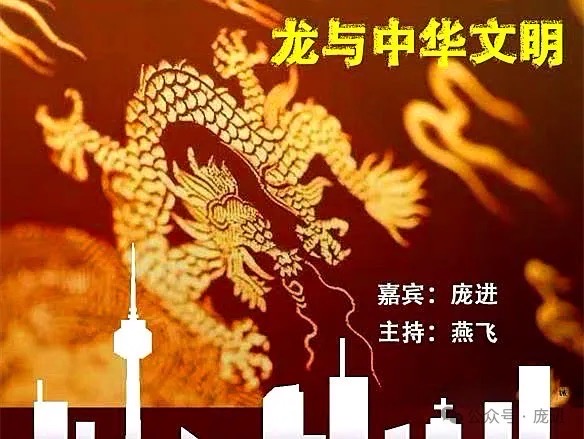
Writer Pang Jin's lecture "The Dragon and Chinese Civilization" was successfully held.
Dragons are participants in, contributors to, witnesses of, embodiments of, and symbols of Chinese civilization.
(Toronto, Canada Chinese Network News) The Canadian Chinese Writers Association, in cooperation with the Chinese Elderly Research and Education Center of Canada, jointly organized a lecture at the Elder Tea House on July 31, featuring Pang Jin's presentation "The Dragon and Chinese Civilization." The event was successfully held in Toronto via video conference, with participants from various locations. Pang Jin, a renowned expert in dragon and phoenix culture research, delivered a vivid and profound explanation on the topic of dragons and Chinese civilization, presenting key viewpoints such as the dragon as a participant, supporter, witness, embodiment, and symbol of Chinese civilization.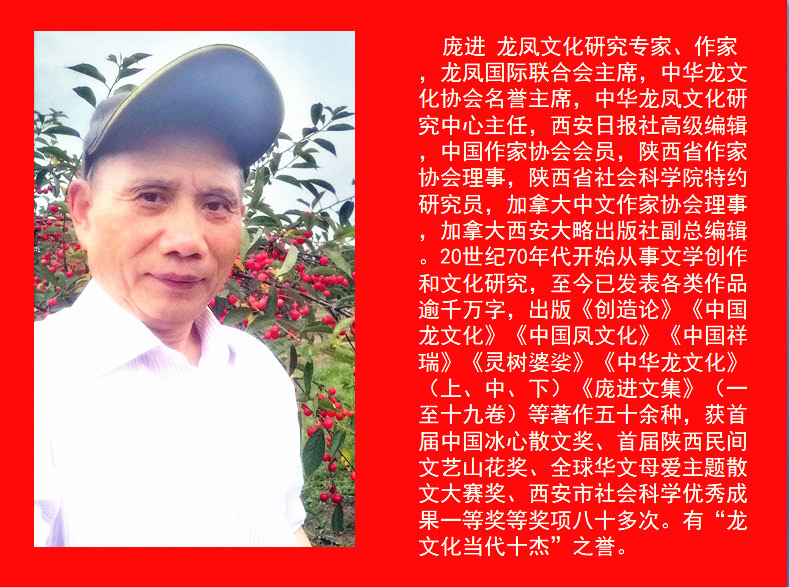
Before the lecture began, Mr. Guo Xibo introduced the situation of the Canadian Chinese Seniors Research and Education Center. He stated that the center is a non-profit social organization registered and established based on Professor Zhang Weiguo's WeChat group, "Seniors' Teahouse," initiated in the Department of Sociology at the University of Toronto. The center upholds the goal of lifelong learning and researches and explores the path to happiness in the lives of Chinese seniors. Its mission is to serve the Chinese senior community in Canada, dedicated to caring for and developing the physical and mental health of Chinese seniors in Canada, improving the quality of life for elderly Chinese people, and creating a harmonious senior community.

This lecture was hosted by Yan Daxia, also known as Yan Fei, the president of the Canadian Chinese Writers Association, who introduced the main speaker, Pang Jin. Yan Daxia stated that Pang Jin is an influential expert and writer on Dragon and Phoenix culture, chairman of the Dragon and Phoenix International Federation, honorary chairman of the Chinese Dragon Culture Association, director of the Chinese Dragon and Phoenix Culture Research Center, senior editor at Xi'an Daily, a member of the Chinese Writers Association, a director of the Shaanxi Provincial Writers Association, a distinguished researcher at the Shaanxi Provincial Academy of Social Sciences, a director of the Canadian Chinese Writers Association, and deputy editor-in-chief of Canadian Xi'an Ontario Publishing House. He began his literary creation and cultural research in the 1970s and has since published over ten million characters of various works. He has published more than fifty books, including “Theory of Creation,” "Chinese Dragon Culture," "Chinese Phoenix Culture," "Chinese Auspicious Beasts," "The Spiraling Sacred Tree," "Chinese Dragon Culture" (Volumes I, II, and III), and "Collected Works of Pang Jin" (Volumes I-XIX). He has received over eighty awards, including the First China Bing Xin Prose Award, the First Shaanxi Folk Art Mountain Flower Award, the Global Chinese Mother's Love Prose Competition Award, and the First Prize for Excellent Social Science Achievements in Xi'an City. He is renowned as one of the "Top Ten Contemporary Figures in Dragon Culture."
Next, Pang Jin gave a 1.5-hour lecture on topics such as “The Definition of the Dragon and the Positioning of Dragon Culture,” “The Dragon and the Study of the Origins of Chinese Civilization,” “The Dragon and the Characteristics of Chinese Civilization,” “The Dragon and the Construction of Modern Chinese Civilization,” and “On Correcting Errors in the English Translation of ”Dragon'."
Regarding “the definition of the dragon and the positioning of dragon culture,” Pang Jin stated: The dragon is a mythical creature invented and manifested by the ancestors of China, integrating various animals such as snakes, crocodiles, lizards, fish, newts, pigs, deer, bears, cattle, and horses, as well as celestial phenomena like thunder and lightning, clouds, rainbows, tornadoes, and constellations. It embodies spiritual connotations such as integration, blessed life, harmony with heaven, and striving forward. The essence of the dragon is the Chinese people's perception, cognition, and deification of the forces of nature and the universe. Through at least eight thousand, or even ten thousand, years of evolution and sublimation, the dragon has become the broad totem, spiritual symbol, cultural icon, civilization marker, belief carrier, and emotional bond of the Chinese nation. Chinese people at home and abroad largely identify themselves as inheritors of the dragon in a cultural sense. From ancient times to the present, the dragon has completed its contemporary transformation, shedding its association with imperial power, conservatism, and weakness, and accompanying the progress of the Chinese nation. It has become a new dragon that is conscious and confident, cohesive and united, adaptable and striving for strength, peace-loving and open, embracing inclusivity, and finding happiness in the happiness of all people. Dragon culture is the general term for all cultures related to this mythical creature. Dragon culture is deeply connected to the roots of the Chinese nation, intertwined with the blood and marrow of Chinese civilization, and resonates with the pulse of the times. It is a participant, facilitator, witness, embodiment, and marker of the entire journey of the Chinese nation and civilization, from its origins, early formation, shaping, prosperity, expansion, to its resurgence.
Pang Jin pointed out that dragon culture is not only the root, tradition, folk, material, and Chinese culture, but also a symbol, fashion, official, spiritual, and world culture. As an important component of traditional Chinese culture, dragon culture plays active and important roles such as participation, assistance, witnessing, embodiment, and symbolic representation in the unification of both sides of the Taiwan Strait, the solidarity of Chinese people at home and abroad, the great rejuvenation of the Chinese nation, and the construction of a community of shared future for mankind. Dragon culture is widely permeated and reflected in the social life of Chinese people. In terms of material utensils, customs and rituals, concepts and theories, in every aspect, there is no field, no group, and no Chinese person who does not relate to dragons.
Regarding the “Research on the Origin and Development of Dragon and Chinese Civilization,” Pang Jin stated: Concerning the historical progress of Chinese civilization, the conclusions of the Chinese Civilization Exploration Project are as follows: 10,000 years ago, the foundation was laid; 8,000 years ago, its origins began; 6,000 years ago, it accelerated; over 5,000 years ago, it entered civilized society; 4,300 years ago, the Central Plains rose; 4,000 years ago, dynasties were established; 3,000 years ago, royal power was consolidated; and 2,200 years ago, a unified multi-ethnic state was formed. Pang Jin cited a series of archaeological discoveries, including the stone-laid dragon from the Xinlongwa culture site in Fuxin, Liaoning; the clam-brick dragon from the Yangshao culture site in Xishuipo, Puyang, Henan; the jade dragon of the Hongshan culture unearthed in Saiqintala Village, Wengniute Banner, Inner Mongolia; the coiled dragon pattern painted pottery dish from the Longshan culture site in Xiangfen, Shanxi; the turquoise dragon-shaped artifact from the Erlitou site in Yanshi, Luoyang, Henan, as well as significant Western Zhou dragon-patterned bronze vessels like the Li Gui and He Zun, and the Kui dragon pattern large roof tile unearthed from the Mausoleum of the First Qin Emperor in Lintong, Shaanxi. These findings powerfully demonstrate that the dragon was a participant, facilitator, witness, embodiment, and symbol in the origin, formation, and early development of Chinese civilization.
Regarding “The Characteristics of the Dragon and Chinese Civilization,” Pang Jin stated: Chinese civilization possesses characteristics such as continuity, innovation, unity, inclusivity, and peacefulness. The dragon has participated in, aided, witnessed, embodied, and symbolized these characteristics of Chinese civilization.
**The Dragon and the Continuity of Chinese Civilization:** Pang Jin provided a series of unearthed artifacts as evidence to illustrate that Chinese civilization has largely experienced six historical periods of continuity: origin, initial formation, shaping, prosperity, extension, and rejuvenation. The dragon has been a participant, supporter, witness, embodiment, and symbol in each of these periods.
**The Dragon and the Innovation of Chinese Civilization:** Pang Jin explained that during the early stages of Chinese civilization's origin and initial formation, relatively simple and primitive “original dragons” appeared on the Chinese land. During the shaping period, more mysterious and abstract “Kui dragons” and more robust and vigorous “flying dragons“ emerged. In the period of Chinese civilization's prosperity, graceful and grand ”walking dragons“ appeared, embodying a coexistence of strength and gentleness. During the extension period, awe-inspiring and ornate ”yellow dragons“ were prevalent. And in the rejuvenation period of Chinese civilization, auspicious, harmonious, beautiful, progressive, and fashionable ”new dragons“ have emerged.
**The Dragon and the Inclusivity of Chinese Civilization:** Pang Jin stated that the dragon is a divine being formed through amalgamation. ”Amalgamation,“ meaning ”inclusivity, compatibility, integration, and combination,“ is the fundamental spirit and an important function of the dragon.
**The Dragon and the Peaceful Nature of Chinese Civilization:** Pang Jin cited the ”Peace Vase“ gifted by China to the United Nations, adorned with dragon decorations on its top, as an example. The ”dragon decoration on the top symbolizes the safeguarding of peace.“
Regarding “The Dragon and the Construction of Chinese Modern Civilization,” Pang Jin said: The dragon's participation, assistance, witnessing, embodiment, and symbolism in the construction of Chinese modern civilization, in general, is to play, promote, and practice the spirit of the dragon's integration, life-giving, harmony with nature, and striving forward. Integration is the worldview and methodology. Life-giving is the value system and teleology. Harmony with nature is the view of heaven and humanity, and the ecology. Striving forward is the view of talent and the theory of strength.
“Regarding the mistranslation of ”Long,“ Pang Jin pointed out: the English translation of ”Long“ as ”dragon“ began over two hundred years ago and is a major error in the history of Sino-foreign cultural exchange. ”Long“ and ”dragon“ have significant differences in essence, function, and image. ”Long“ is a symbolic emblem of the Chinese nation and holds an important position in the dissemination of Chinese culture and national identity. Although it has carried some negative connotations historically, it generally represents goodness and beauty. In Western culture, ”dragon“ is the name of a monster and a demon, an object of denigration and slaughter. While it also carries some positive connotations, it generally represents evil and ugliness. Entering the 21st century, scholars began to ”rectify the English translation of Long,“ calling for ”Long“ to be translated as ”loong.“ To advance this work, we have continuously undertaken extensive efforts, producing broad and far-reaching impacts. These include drafting and issuing ”An Open Letter to All Chinese People Regarding the Correction of the English Translation of Long,“ planning, contacting, and providing textual references, supporting and solidaritying with members of the National Committee of the Chinese People's Political Consultative Conference such as Yue Chong and Lei Zhenmin, and representatives of the National People's Congress such as Wang Jun and Jia Pingao, and submitting ”Suggestions on Correcting the Translation Errors of Long and Dragon" to the National Two Sessions for four consecutive years. Pang Jin believes that with the official English name "Loong Chenchen" for the mascot "Long Chenchen" of the "2024 China Media Group Spring Festival Gala," China Global Television Network (CGTN) reporting the "New Year Loong Dance Challenge" on January 9, 2024, translating "Year of the Dragon" as "Loong Year," and Xinhua News Agency publishing the video "How Should 'Long' Be Translated?" on February 7, 2024, supporting the English translation of "Long" as "loong," the work of "rectifying the English translation of Long" has achieved a breakthrough.
It is reported that writer Pang Jin's lecture "Dragons and Chinese Civilization" is the first in a series of lectures co-organized by the Association of Chinese Writers in Canada and the Chinese Canadian Seniors Research and Education Centre. Subsequently, there will be more lectures, including writer Yan Daxia's literary lecture "Leading Figures in Contemporary Chinese Literature: Mo Yan, Wang Meng, Zhang Xianliang, Tie Ning," writer Lang Li's lecture "The Growth of the Association of Chinese Women Writers in Canada," and acclaimed novelist Yan Bo's lecture "My Reflections on Writing Novels."