
A New Song, A Classmate's Love; Where on Earth Is There No Longing? - Reading Writer Yan Fei's "Four Beauties of My Classmates"
Zeng Wanzi
Thirty years after reuniting with university classmates, poet Yan Fei's heart stirred with emotions and passion. Following the poetic charm of the Tang Dynasty, he composed a seven-character regulated verse titled "Ode to Four Beautiful Classmates" for four female classmates: Zhao Dongmei, Yu ShuRong, Lu Yi, and Xu Ping. This poem was first published on Phoenix Net Hainan Channel's "Phoenix"品Reading Column。Later, it was reposted and reviewed by many websites such as China Poetry Network, Wenxue City, Tianya Club, KDnet, and Huawen.com, and was recognized as a classic by multiple Chinese and foreign recitation teams.WorkRecite 。
In this world, what is most pure? The friendship of classmates! In this world, what is most precious? The sentiment of fellow students! Seas change and mulberry fields transform, and worldly affairs shift, but there is an emotion in this human world that, though we cannot gather often, always makes us feel like old friends upon meeting. This is the feeling of fellow students, the friendship of classmates.
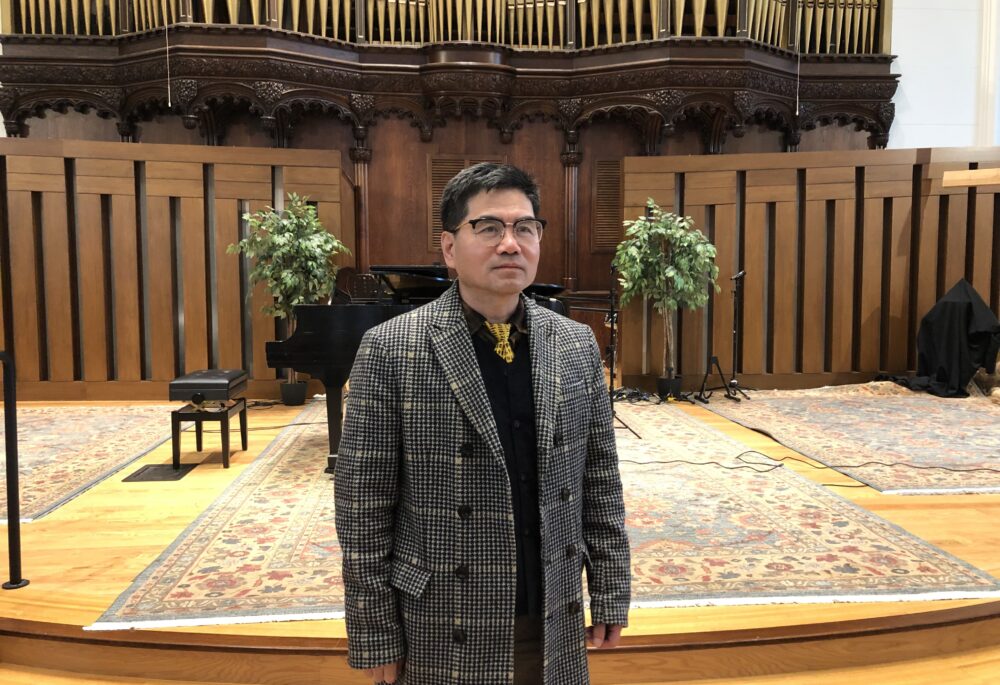
Recent photo of author Yan Fei
Yan Fei, a writer and poet, currently serves as the President of the Canadian Association of Chinese Writers. His representative work is the "Hainan Dream Trilogy." He excels in classical poetry.Created in memory of a legendary figureChen XiaoxuThe ancient long poem "A Dawn Red Chamber Goodbye》Appeared on Canadian National Television, receivedLiteratureCritically acclaimed。More than thirty years ago, Yan Fei, whose original name was Yan Fei, was studying at Changsha Communications Institute (now renamed Changsha University of Science and Technology). At that time, there were 34 students in their Class 4 of Highway Engineering, with only 4 female students. It is said that each of them was beautiful and elegant, and their names were Zhao Dongmei, Yu Shuaiyong, Xu Ping, and Lu Yi. They each bore a resemblance to stars such as Zhang Jinling, Song Zuying, Gong Li, and Wu Jiali, and were known as the “Four Beauties of Class 4.” In the blink of an eye, the old tree in front of the gate sprouted new buds, and the withered tree in the yard bloomed again. However, at a reunion 30 years later, Yan Fei was amazed that the four beauties of yesteryear were “still beautiful, still elegant,” so he wrote a seven-character regulated verse for them with deep emotion – "Ode to the Four Beauties of Classmates."
Three provinces' classmates for years, a lifetime of friendship always cherished.
A sad drop of Xiang River water, Turns into a fragrant pool, repaying the gushing spring.
Winter sweet blooms on the roadside, not contending for spring, A hibiscus emerging from water finds a kindred spirit.
A brief encounter brings much joy, a resolute choice leads to uncontrollable emotions.
……
Yan Fei is nostalgic. He pours out his poetic sentiment, naturally embedding the beautiful names of his four classmates—“Mei,” “Rong,” “Ping,” and “Yi”—into his poems. Ban Gu said in “Western Capital Fu”: “May guests express their nostalgic thoughts, and reveal their deep feelings for antiquity.” And Yuan Zhen in "To My Foster Brother Shi Ze of Qu Prefecture, Wu": "Tears due to separation and remembrance, gaze back at the river and mountains, as if ten thousand lines." Yes, nostalgic people have vivid memories and soft hearts. Nostalgic people are reserved yet rich, easily overflowing with emotion at a familiar word, a familiar scene, or a familiar face. Yan Fei is just such a person. Facing his old classmates, his thoughts drifted back over thirty years ago. Those were times when the sun was warm, and the years were peaceful. You had your elegance, she had her beauty, laughter was hearty, feelings were wonderful, and smiles were pure. Fierce winds blow the white sun, swift time rushes westward. Years are like poetry, like paintings, like strings of a lute. That was a time of burning passion, a time of fiery youth!
Nostalgia is an emotion, a complex that people find hard to shake. The reason nostalgia remains fresh and timeless after being polished by the years is not due to its own great charm, but because old people and old events provide new material, allowing people to trigger new insights into life and reawaken their thoughts. As Yan Fei navigates through various relationships and busies himself in the mortal world, he suddenly looks back and discovers that the camaraderie of his former classmates is the purest and most precious. Poet Yan Fei has ten thousand kinds of tender feelings, because nostalgia gives him vibrant ideas and new motivation. Nostalgia also easily intoxicates people. Through every word and sentence in "Four Beauties of Classmates," we feel that Yan Fei is also intoxicated.
Four beauties of the Central South and Xiang, with orchid hearts and fairy souls;
Her beauty shines brighter than the stars, and her talent surpasses professors by three points.
……
The winding paths of Nan Yue's mountains and waters lead on, three hurried days but the desire is not yet quenched.
How many days until my beauty returns to my dreams, to embrace the Twelve Peaks of Mount Wu together!
……
Yan Fei is also sentimental. Some say: "Parting is a poem, worthy of our soft chanting; reunion is a song, worthy of our hearty singing." Thirty years later, when the classmates reunited, among the 34 classmates, Yan Fei's affectionate gaze was fixed on the only four female classmates. He wrote poems and sang songs, with precise couplets, exquisite wording, and beautiful verses. Every sentence was filled with deep emotion, solely to praise these four beauties: "Thank heaven, thank earth, thank the Lord for letting us meet, thank my classmates for leaving me beautiful memories, thank you for being in my life!" The tea in the teacup still smelled fragrant, and the wine in the wine glass was still mellow. So Yan Fei raised his glass... In fact, Yan Fei is not someone who lives in memories; he just wants to keep this beautiful moment as a memento. Yan Fei knows that true ladies possess not only beauty but also temperament and soul. If beauty makes a woman radiant, then talent can make a woman charming.
It is said that it takes a hundred years of good karma to share a boat ride, a thousand years to share a bed, and five lifetimes to be classmates. Facing his female classmates, Yan Fei said, “Seeing your smiling face again, your laughter and charm; sitting opposite you, talking earnestly, sharing a knowing smile and clinking glasses at lavish banquets; holding your hand, leaning against the green mountains, striking a delightful pose for a drunken tango, superimposed on the border skyline between China and Vietnam; holding your hand, embracing you, pressing my weather-beaten right cheek against your flower-like smiling left cheek...” Yan Fei's four beautiful female classmates are now all professors and senior engineers. Rather than saying Yan Fei appreciates women, it's more accurate to say that these four exceptional women are truly worthy of appreciation. Over 30 years ago, those who could get into university were “chosen ones.” At that time, female students in science and engineering departments at famous universities were extremely rare; they could truly be described as one in a hundred. The passage of time has not taken away their youth; instead, it has made these intellectual women even more elegant. Yan Fei's heart is like a kettle of ice, like silver moonlight, transparent, warm, magnanimous, and true, and Yan Fei's “sentimentality” has nothing to do with romance or moonlit nights.
Shaoshan, Hengshan, Jinggangshan, graduation comes and goes in the blink of an eye!
……
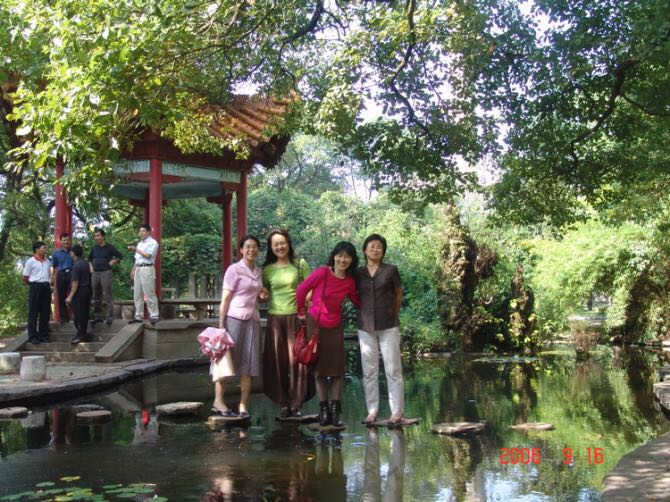
Four Beauties of the Same Class Paintings
Yan Fei is even more talented. Yan Fei's talent is manifested in his literary talent. Thirty years later, as the poets' hearts surged with emotion and passion, they warmed wine and ground ink, following the poetic charm of the Tang Dynasty, to compose a seven-character regulated verse for the four beautiful classmates. Every sentence is a classic, every line is orderly, and every word is a pearl. As the saying goes, poetry and wine have always been fueled by passion, and even knowing one's destiny does not diminish one's youth! Inspired by the scene, Yan Fei's poetic fervor surged, and he spontaneously recited the poem "The Farewell of Four Beautiful Classmates." It was first published in the "Literary Masters' Reading" column on Phoenix Net and was later reposted and reviewed by many websites, including China Poetry Net, Literary City, Tianya Club, Kadie Net, World Chinese Net, US Chinese Net, Canada Feng Hua Net, and Wannsheng Online. It has also been recited as a classic work by numerous Chinese and foreign recitation groups, demonstrating its wide dissemination and popularity.
The “Poem of Four Beautiful Classmates” is elegant in its writing and profound in its meaning. The poetic meaning flows smoothly and unhindered, with a charm reminiscent of Li Bai's “Bring in the Wine.” Li Bai said, “Bells and drums, delicacies of jade, are not worth valuing; I only wish to be drunk forever and never wake. Since ancient times, sages and virtuous men are all lonely; only drinkers leave their names.” Yan Fei said, "The moonlit night in the border town is steeped in poetic sentiment, the morning light in the sugarcane fields reflects smiling faces! The melody of 'Three Variations of Plum Blossom' is deep in meaning, hibiscus flowers divide the two sides of the face." The "Poem of Four Beautiful Classmates" is catchy and its language is ornate, with exquisite parallelism and allusions. The distant artistic conception makes one recall Bai Juyi's "Song of Everlasting Sorrow" with its similar melody: "Naturally beautiful, hard to discard; one day chosen to be by the King's side. A glance back and a smile create a hundred charms, the beauties of the six palaces lose their color." Yan Fei, inspired, wrote it spontaneously and in one go. The "Poem of Four Beautiful Classmates" makes one seem to hear sounds just by reading the words, creating infinite beauty and imagination. Don't Zhang Ruoxu's "Moonlit Night on the Spring River" and Wu Weiye's "Song of Yuan Yuan" also have such characteristics?
……
Youth sings in Tujiachong, prime of life in Jinpenling;
Wandering the sea of books, toil is the boat; seeking the path on the mountain of books, diligence is the trail.
I have also planted trees on the banks of the Xiang River, and I have also wandered on Mount Yuelu.
Four years of dreams, cultivating a barren land, I can't forget the unique initial state;
The campus scenery is infinitely beautiful, but Wen Jun does not love the sickly Xiangru.
……
The passage contains allusions and anecdotes. “Wen Jun” clearly refers to the talented woman of the Han Dynasty, Zhuo Wenjun; “Xiangru,” naturally, is the equally talented man, Sima Xiangru. These lines of poetry are playful, encompassing countless campus romances, innocent and pure. The protagonists might be today's bureau chiefs, professors, or senior engineers, or perhaps former class presidents or Youth League branch secretaries from back then... But the male protagonist who sparks even more imagination is Yan Fei himself. It's evident that the poet here compares himself to “Sima Xiangru.” It's just that Yan Fei was the president of the student martial arts association during his studies, and he was physically strong. Calling himself “sick Xiangru” is truly humble. "Wen Jun does not love sick Xiangru" suggests that perhaps someone among these four beauties once kindled a gentle, unrequited love in the poet Yan Fei. Time flies, the mortal world surges on, but the poet remains tight-lipped about who the specific "Wen Jun" refers to, leaving it forever a mystery to us.
A person's talent is accumulated over many years. Yan Fei has lived in Canada for many years since moving from Hainan. During his time in Hainan, he was also known as the “Number One Writer of Hainan.” His "Hainan Dream Trilogy" was a best-selling literary work that was widely popular during the period of Hainan's development and opening up in the last century. It consists of three novels: "Hainan Dreamless," "Hainan Startled Dream," and "Hainan Seeking Dream," and it is also his representative work. Many years have passed, and even now, a search on any internet engine will reveal numerous web pages containing content from this trilogy, as well as reports and book reviews. The sensation it caused back then can be seen as a glimpse of its impact. Time flies, when will new dreams be fulfilled? It is said that Yan Fei, currently across the ocean, has a new plan to continue his life's new dream trilogy, which has us readers, both old and new, eagerly anticipating it.
A new song and the friendship of classmates, where in the world does one not long for them? Following “Four Beauties of Classmates,” we believe that Yan Fei, returning to his writing state and to literature, will soon reappear before us with his new works, bringing us a surprise and a stunning revelation. Because we know that Yan Fei's “Four Beauties of Classmates” not only possess both talent and appearance, but the well-read scholar Yan Fei is also "three points superior to a professor in talent"!
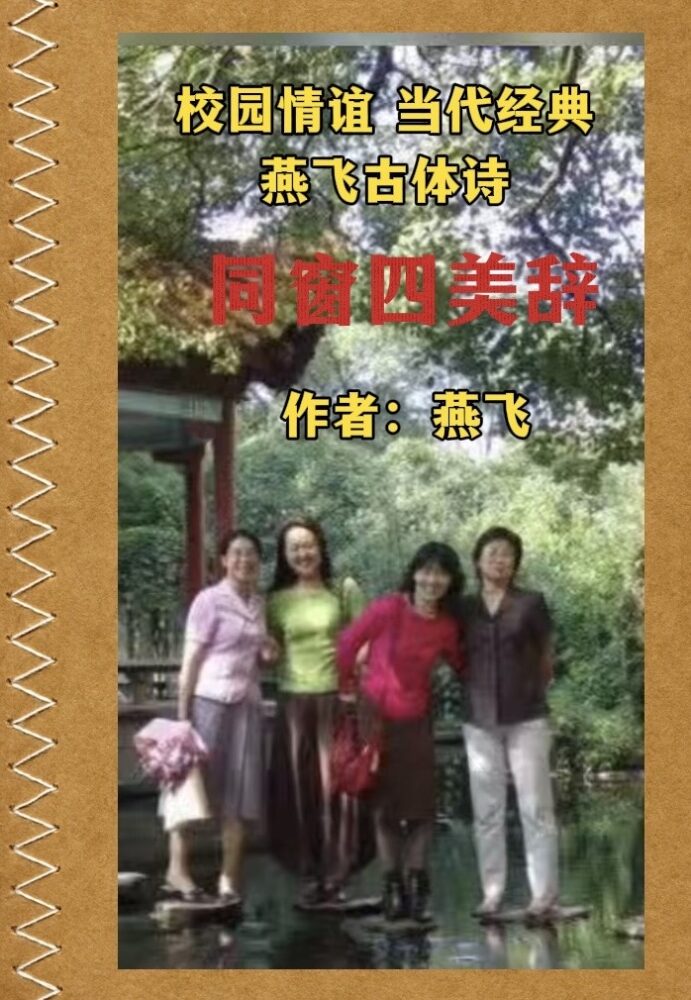
Appendix: Ode to the Four Beauties of My Class (Full Text)
Yan Fei
Four beauties of the Central South and Xiang, with orchid hearts and fairy souls;
Her beauty shines brighter than the stars, and her talent surpasses professors by three points.
Three provinces' classmates for years, a lifetime of friendship always cherished.
A sad drop of Xiang River water, Turns into a fragrant pool, repaying the gushing spring.
Winter sweet blooms on the roadside, not contending for spring, A hibiscus emerging from water finds a kindred spirit.
A brief encounter brings much joy, a resolute choice leads to uncontrollable emotions.
Four years of dreams, cultivating a barren land, I can't forget the unique initial state;
The campus scenery is infinitely beautiful, but Wen Jun does not love the sickly Xiangru.
Youth sings in Tujiachong, prime of life in Jinpenling;
Wandering the sea of books, toil is the boat; seeking the path on the mountain of books, diligence is the trail.
I have also planted trees on the banks of the Xiang River, and I have also wandered on Mount Yuelu.
Shaoshan, Hengshan, Jinggangshan, graduation comes and goes in the blink of an eye!
Thirty years have passed in the blink of an eye, time flies as fast as lightning.
Let's meet again in Southern Xinjiang, travelers from the five continents and four seas!
Embracing, love is more sincere; shaking hands, laughter brings joy.
Playing and tossing the embroidered ball with you, sharing cups and drinking together with you!
The bamboo forest sings at the great King's Beach, Hand in hand we journey through the elite gardens.
The riverside town's moonlight casts a poetic glow, and the sugarcane field's morning light reflects smiling faces!
The plum blossoms' three variations convey deep meaning, like hibiscus parting on either side of a face:
The setting sun's tango stands resolute, always relying on green mountains that paint the azure clouds!
The winding paths of Nan Yue's mountains and waters lead on, three hurried days but the desire is not yet quenched.
How many days until my beauty returns to my dreams, to embrace the Twelve Peaks of Mount Wu together!
Seas turn to mulberry fields, how long will this ancient poetry cherish the lingering affection?
Even though we are thousands of miles apart, my longing for you will still reach you at the ends of the earth!
Inscription: Thirty years later, classmates reunite. The wind blows through the white sun, time flies west. Of the 34 classmates from Class Four, Highway Department, Changsha Communications Institute (now renamed Changsha University of Science and Technology), there were only four female students: Zhao Dongmei, Yu Shuirong, Lu Yi, and Xu Ping. Each was beautiful and elegant, known as the "Four Beauties of Gong Si." Time is like poetry, like a painting, like strings of a zither. Finally, reunited with you all. The Four Beauties of Gong Si are now all professors and senior engineers, as elegant and beautiful as ever. Our reunion in the southern border of China in October is still vivid in my memory. Seeing your smiling faces and hearing your joyful laughter; sitting opposite you, chatting away; exchanging knowing glances and toasting each other at the grand banquet; holding your hands, with mountains behind us, striking a pose for a drunken tango, superimposed on the border of China and Vietnam; holding your hands, embracing you, pressing my battle-worn right cheek against your left cheek, which blooms like a flower… Class Gong Si had more men than women, and most of the 30 male students achieved great success in their careers. There were officials, professors, wealthy businessmen, celebrities, and worthy individuals. Each stood out and led a splendid life. Xiong Youshan, Zhan Jianhui, Tian Zhongchu, Ding Lun, Shou Xu, Bao Long, Zuan Jin, and others were all pillars of the nation. Luo Jian, Luo Jing, He Wei, Xu Zhang, Old Deng, Hui Guang, Zhi An, Dai Gong, Guo Qin, A Jiang, Old Zuo, Old Qiu, A Hu, A Xing, and others… were all leaders in their respective fields. It pains me to omit the brothers in this piece. I will settle this literary debt at a later date. Today, I write a poem and sing a song, to solely praise the four female students of Class Gong Si. Expressing the camaraderie of classmates, not about romance. It is New Year's Day, the beginning of a new year. The poet's heart is stirred, feelings surge. Warming wine and grinding ink, following the poetic style of the Tang Dynasty, I compose a seven-character regulated verse for the four beautiful classmates, titled "Ode to the Four Beauties of Gong Si." As it is said, swallows fly as they bring wine, the poem praises the four beauties! Poetry and wine have always been fueled by passion, even knowing fate, one can still be youthful! January 1, 2017 Toronto

Writer Zeng Wanzi
Author Introduction: Zeng Wanzi, female, member of the China Writers Association, director of the Hainan Writers Association, and vice chairman of the Haikou Writers Association. Her ancestral home is Wenchang, and she grew up in Haikou. She currently teaches at the Foreign Language Teaching Department of Hainan Vocational College of Science and Technology, holding the position of associate professor. She has been fond of literature and art since childhood and has been writing diligently in her spare time, dedicated to exploring local Hainan culture. Her writings touch upon local customs, human relationships, and the various facets of life. She has published over ten literary works, including full-length novels, full-length intangible cultural heritage records, full-length inspirational books, and collections of prose and essays.