He Gu: Ten Days on the Yangtze
Kazuya
April 20, 2025
Xi'an to Chongqing High-Speed Railway
The road to Shu is difficult, more difficult than climbing to the sky.
Where is Li Bai now? I look up to the white clouds.
The roads to Shu are easy; a thousand miles in one day.
Travelers, do not ask, the elder is seventy-three.
The outbound trip was guided by a ride-hailing platform driver, who handed off to a middle-aged or elderly person, who then handed off to a young person. They contacted the driver and boarded at the ride-hailing pickup point. Earning 28 yuan was not easy; it was like a clandestine meeting of the underground party in the Republic of China's wartime capital, thorough and inescapable, arriving at Jiefangbei to check in.
Eating hot pot on Shaanxi Road. Hongyadong pier, layered like golden pavilions, the river water gleams, with cruise ships, fishing lights, drone shows, and crowds of onlookers.
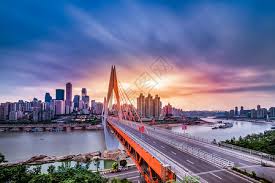
Chongqing at night, the lights of the mountain city meet the sky, bridges crisscross the river, and traffic surges.
April 21st
Chongqing to Fengdu
I'll have a bowl of mixed noodles for lunch.
The river water was shallow, so we took a minibus to Fengdu. Along the way, green mountains stretched endlessly, dotted with white-walled, blue-tiled houses of mountain folk.
On the banks of the Fengdu River, I bought a disabled person's straw hat for 10 yuan. The porter carried the luggage box, moving heavily.
Enter the room, the balcony faces the river, sit and observe.
During the Republic of China era, Magistrate Nai Yuanzhang of the Yanchang Oil Field was meritorious. He cooperated with the Japanese and successfully extracted oil. At the age of seventy, he retired. His ten family members moved his wife's coffin back to their ancestral home in Fengdu, a journey of a thousand miles. How could they bear such a hardship!
Seafood buffet, the salmon with wasabi was delicious. The eight people at my table were from Shanghai, judging by their accents, and they were very polite. They mentioned there was an elderly gentleman with a cane among them, who was 98 years old. I was impressed! There was also an elderly couple, who have backpacked through over 80 countries at their own expense – amazing! The night was very quiet. I heard a loud noise outside the window and felt the boat lurch; they said it was the sound of the anchor being raised.
April 22
Fengdu to Zhongxian
Forty years ago in Fengdu,
My husband came yesterday and came again today.
The cable car stopped, and we rested our feet.
No more climbing, see ghosts.
Heavy rain, the sky and water merge into one, with vast white mist. Pedestrians throng.
You ask about my return date, but there is no fixed date yet.
Night rain in Bashan swells the autumn pond.
When shall we trim the lampwick together by the west window?
However, speaking of a night of rain in Bashan.
Li Shangyin - A Night Rain Sends Off My Northern Friend
The movie "Night Rain on Bashan," directed by Zhang Yigong and starring Li Zhi and Zhang Yu, is still vividly remembered. Bai Hua wrote the lyrics "May life be filled with more reunions and fewer partings."
"Separation," music by Takada, sung by Zhu Fengbo. It's deeply moving.
Evening, Zhong County. Cross the Yangtze River Bridge.
Live-action dance drama "Beacon Smoke Three Kingdoms." Produced by the Xi'an "Song of Everlasting Sorrow" team in 2017. A thousand-person mobile theater. Before the performance, shouting and yelling with calligraphy promotion is not as good as playing the dance drama music. It's a waste of the precious time of thousands of people who have traveled from afar. Majestic momentum, spectacular acrobatics.
Night voyage. On one side, the lights of moving uphill ships twinkle. The mountains on the opposite bank are dark, and the night sky is hazy. Sitting and traveling hundreds of miles at night, waves crash with a *hua la la* sound, the river's surface faintly ripples, clear and greenish.
At six o'clock, the eastern sky begins to lighten, mountain silhouettes gradually emerge, with white houses dotting the shoreline. Tall buildings appear, half-hidden in the white mist.
We've reached Baidi City.
During the An Lushan Rebellion, Li Bai was fortunately released from the rebel army's prison. At that time, he bid farewell to Baidi City amidst colorful clouds, but the sky was overcast with no colorful clouds. He went downstream, and a thousand miles to Jiangling were covered in a single day. Here, the sound of apes was not heard, only the roar of waves, as if entering a realm of solitude, his light boat already passed ten thousand mountains.
Throughout history, how many people have drifted on this river, and how many events have become mere laughter?
Before reaching Baidi City, I felt a little sad.
Upon reaching the 6th floor terrace, the sun was shining brightly. I could smoke a cigarette. Gazing at the surrounding mountains and the flowing river, my mind felt clear and open.
Qutang Gorge, with its highest point forming a pointed peak, is the most majestic summit of the Three Gorges. Like the work of divine knives and axes, the water gate is opened. Along the sheer cliffs on both banks are winding, undulating ancient plank roads. In the rock walls are cavities where the ancient Ba people's suspended coffins are hidden. I was amazed by a massive crane on the right bank, its outstretched arm seeming to wave at travelers.
The sun was scorching on the deck as tourists admired the scenery, and then they passed through the dangerous Kui Gate.
April 24
Cross the Three Gorges
At midnight, the green river surface and mountains disappeared outside the ship's window, blocked by a steep cement and stone wall. The ship moved forward slowly for a while, then stopped. There was a sense of enclosed gloom in this canyon locked by the stone wall. The ship had entered the lock. Once the water level dropped and the ship emerged, it would have passed the dam. Going upstream, the water level would rise, lifting the ship. Human daring and wisdom had tamed the roaring Yangtze River here.
Sandouping. Large ships were docked in a narrow channel, and the vast river water was not visible. I felt a chill and took cold medicine, but I still felt weak. Looking out the window, I saw 12 teams, totaling 600 people, disembarking the ship one after another to see the dam. I felt a sense of melancholy.
Xiling Gorge. The Tujia people's Three Gorges home, dwelling on the cliffside, singing and dancing.
The tourists on the river are the audience, and the moving boat is the stage. The Tujia song and dance on the cliffs are the fixed stage. Or, upside down, they are each other's spectators and performers.
Exiting the gorge, the water and sky merged into one, and the distant mountains were as dark as eyebrows. Gradually, clusters of buildings appeared, and upon entering Yichang, the Gezhouba dam gates opened.
The lone sail vanishes beyond the blue sky's edge, Only the Yangtze River is seen flowing to the horizon.
Can you provide even one or two examples of the friendship between Li Bai and Meng Haoran today? The degradation of humanity, how time flows like water. Apart from the dust of material and technological transformation, little remains of human emotion and conscience.
Once I have seen the ocean, other waters mean nothing. Having seen the clouds of Wu, other clouds are not clouds.
Where is Yuan Zhen? In this age of gold, how much love remains?
Regarding the meal: 600 people gathered in an orderly fashion, amiable and courteous, truly like a united and loving large family. The food was diverse and delicious, a culmination of global cuisine. The servers were young, slender, kind, and polite. There were no loud disturbances; people of all kinds, under the value of equal treatment, mingled peacefully. Guests were not divided into classes, with no distinction between farmers, workers, merchants, scholars, officials, or commoners. An ideal utopian society is apparently like this.
However, a thousand yuan per person per day, all-inclusive, without financial compensation, is out of the question. There's no such thing as a free lunch. Humans, nature, with its cloudy and clear skies, gentle breezes, and flowing rivers, all moving along with time on a leisurely cruise – everything is harmonious and beautiful.
A flock of sheep. A flock of old sheep, the vast majority of elderly men and women, herded by a young captain, a flock of sheep gathered on the same boat from all over. It takes a thousand years of good fortune to share a boat.
Thirty years ago, I also took a cruise down from Chongqing to Yichang, then returned to Xi'an, and then headed to Hainan Island. Water, always close to water, river water, sea water.
On this boat crossing, the people are gone, though the things remain. My companions from the past are scattered, with no news of them – are they dead or alive? Life's ferry crossing, the near shore and the far shore, drift now in the middle of the water.
Where is my hometown at dusk? The misty waves on the river make me sorrowful.
Thirty years from now, where will those who sailed the same boat be?
Noah's Ark, a myth, is also the current state of humanity.
April 25th
Yueyang
Sunrise flowers on the river are redder than fire, Spring on the river is greener than blue. How can I not miss Jiangnan?
Bai Juyi, the Tang Dynasty poet who wrote “The Song of Everlasting Regret” when he was the magistrate of Zhouzhi County. In 2008, I served as the originator and cultural consultant for the dance drama "The Song of Everlasting Regret," and invited Wang Meng to engage in a dialogue about "Huaqing Xiu." This production has generated billions in revenue to date. Are we not simply echoing the thoughts of ancient people and indulging in nostalgic sentiment?
Before my eyes, the river blossoms are like fire, and the ferryboat meanders across the wide river surface, a brilliant world of golden hues.
Bai Juyi's poems are not mere trivialities, but rather are like teeth, gnawing at the Chinese characters, still crunching to this day!
A table for eight, six of whom were Shanghainese and couldn't understand what was being said. It was like watching a play from the side. This group of people, despite their varied attire, all declared the twilight of their years with age spots, some deeper, some lighter. Having experienced different life stories, Kyoko uses her current comfortable life. They are all calm, without temper, living day by day.
The river water gradually changes from greenish-blue to a pale yellow, the color of earth.
The sky is clear. I haven't left the house for two days and have been resting in bed. I feel I have regained my strength and will go to see Yueyang Tower.
Enter Dongting Lake.
Yueyang Tower overlooks the world, Dongting Lake contains the world's waters. Baling boasts a magnificent panorama.
Fan Zhongyan's "Record of Yueyang Tower." To be concerned before all others in the world is concerned, and to be joyous after all others in the world are joyous.
Smoking a cigarette on the balcony outside the window, there was a knock at the door. Someone said they were checking a fire alarm; a red light was flashing on a small box on the roof. The balcony door was not closed, and the smoke drifted to the small box and was detected? Apologized profusely.
My deskmate is from the north, and I'm the only one from the south. I can't eat greasy food, so I ordered a bowl of noodles. They're dried noodles, and the spicy chili oil is authentic. Southerners call noodles "miantiao," and the extra character is unnecessary. When they call rice "fan," isn't noodle also a kind of "fan"?
April 26
Wuhan
I roam my homeland in my mind, A sentimental fool, they'd say, To age so soon. Life's a dream, One cup I'll pour to the river moon.
Su Shi
A thousand years later, I follow in Su Dongpo's footsteps, living in exile on Hainan Island for eight years, staying a few years longer than the venerable scholar.
Visiting Red Cliff today feels like a return trip, filled with reflections on the past and thoughts on the present. Alas, time continues to flow, and the principles of the past and present remain the same.
Arriving at Wuhan Port. Tall buildings stand in rows, stretching along the horizon. One can see a concentration of people, bustling traffic, what a splendid world.
This reminds me of Wuhan writer Fang Fang. I recall thirty years ago, Fang Fang, Chen Rong, Chi Li, Zhao Mei, and Gu Yan visited Shanghai's South Island. We were happy to host them as guests, entertaining them at a small restaurant on Hangtian Road. It was quite enjoyable.
The old friend bids farewell at Yellow Crane Tower,
He sails down Yangzhou in the misty March blooms.
The lonely sail vanishes into the blue sky,
Only the Yangtze River flows to the horizon.
Where is my old friend? The river water flows as before.
Passed through Wuhan four times.
Xi'an Federation of Literary and Art Circles in the 1980s, Hainan in the 1990s, Shaanxi Federation of Literary and Art Circles in the 2000s, and self-travel in the 2020s.
Water in the city, city in the water.
Hubei Provincial Museum, Marquis Yi's chime bells, King Goujian of Yue's sword. Many visitors, mostly students. The chime bells are enormous, and the other bronze artifacts are exquisite, a dazzling array. I wanted to see the chime bell music and dance performance, but the queue was until 3 o'clock, so I had to give up.
Smoking outside, there are more young people than old ones. In a tour bus of people, there are two or three smokers, but the non-smokers are the majority. I won't go with the crowd. The tour guide led the group inside, and I alone left the group and wandered around.
Marquis Yi of Zeng, a ruler of the Zeng state (Sui state) in the early Warring States period, of the Ji surname. Reigned from 475-433 BCE, lived to be 42 years old, and reigned for thirty years.
April 27th
Mount Lu
"Mao Zedong at Lushan," photographed by Jiang Qing in 1961.
Mao Zedong's poem "To Comrade Li Jin on the Photograph She Took of the Immortal's Cave on Lushan":
In the vast twilight, I see a mighty pine; though chaotic clouds fly by, it remains serene. Heaven birthed a fairy cave; infinite splendor lies on perilous peaks.
Tujia cuisine restaurant. Delicious.
Kuling American School was founded in 1916 with the aim of providing modern, formal education and moral and religious upbringing for the children of foreign emissaries, European and American merchants, and missionaries stationed in China at the time. The American School enrolled over 2,000 students from countries like Europe and America, and was an important institution for foreigners in Central China at the time.
One mountain stands majestically by the great river, Leaping up through four hundred winding green terraces.
Coolly I watch the world with a glance, Warm winds blow and rain sprinkles the river and sky.
Clouds cross the nine streams, a yellow crane floats by; waves surge below the three Wu regions, raising white mist.
Where has Tao Ling gone? Can he still farm in Peach Blossom Spring?
Mao Zedong's "Climbing Lushan"
Its cursive script is grand and unrestrained, flowing and vigorous, truly a divine work of ancient and modern times.
At 8:30 PM, the cinema on the first basement level of the Century Cruise Ship will screen "Lushan Romance." It is said to be one of the films with the most screenings and audience members in the world.
I recall my eight years living as a guest on Hainan Island, where I collaborated with Guo Kaimin, the protagonist of this film, on a TV drama script. Later, my wife worked in the art department at Zhaokai Film Company. My novel, "The Island and Hometown," fictionalized this experience. Looking back brings back old memories, it feels like a chance encounter. Life is full of reunions.
April 28
Jiuhua Mountain
Coincidentally, Yan Fei, the chairman of the Canadian Chinese Writers Association, invited me to contribute a piece. My novella "Imperial City," which I wrote last year and recounts the dramatic events within a calligraphic and painting association, was published on Huawen.com.
Visiting Mount Jiuhua now.
My white hair is three thousand zhang long, It resembles my sorrow, which is equally long.
Without a mirror to dimly reflect, where can one find autumn's frost?
Li Bai's "Autumn River Song" was created in the thirteenth year of Emperor Xuanzong of Tang's Tianbao reign (754). After being granted gold and returning to his mountain retreat, he traveled through Jiangnan, depicting the labor scenes of Qiupu in Chizhou, Anhui.
The Jiuhuashan cable car line had over an hour's wait due to extreme overcrowding.
Wu Guixian passed away. Wu Guixian (1938-2025), a legendary textile worker from the Mengtao Group. A long-form documentary novel "Blooming" by Gu Gu.
Li Bai: I wish to wave my hand, who will follow me? You, as the host, lie here among the clouds and pines.
Watched the film "Chang'an" tonight. Gao Shi, the Tang Dynasty poet with the highest achievements. Gao Shi and Li Bai's interactions offer a glimpse into the Tang Dynasty and the literary scene.
My white hair is three thousand zhang long, It resembles my sorrow, which is equally long.
Without a mirror to dimly reflect, where can one find autumn's frost?
Li Bai's "Autumn River Song" was created in the thirteenth year of Emperor Xuanzong of Tang's Tianbao reign (754). After being granted gold and returning to his mountain retreat, he traveled through Jiangnan, depicting the labor scenes of Qiupu in Chizhou, Anhui.
Gao Shi:
The capital of yesteryear is left behind, I know your talent and ambition are new.
You should still write well, don't sigh about poverty in office.
And again I grieve for the long separation; otherwise, I would not be so sad.
A gentle breeze stretches for miles, a traveler returns down the river.
April 29
Yangzhou
Slender West Lake
Du Mu:
Distant blue hills lie in view, and the water stretches far and wide; autumn has ended in Jiangnan, yet the grass has not yet withered.
Twenty-four bridges under the bright moonlit night, where is the jade maiden teaching the flute?
Rowing on the lake, there is a stone inscription of Mao Zedong's calligraphy of this poem. I don't know when or where it was written. The lake is not large, not fertile, but lean. It is also delicate and beautiful. There are many bridges, all arched. Crossing one bridge involves ascending and descending twenty-four narrow steps. Few people are taking boat rides; there are many small scenic spots, places to drink tea and rest. The white pagoda is tall and majestic, pure and solemn.
Thinking back to visiting Du Mu's tomb in Chang'an last year, it was just a large dirt pit. It was the Du family ancestral tomb, containing Du Fu's ancestors, and soil was taken from it to build ox stalls.
How Du Mu traveled from Chang'an to Yangzhou and back, amidst the wind, flowers, snow, and moon, with beautiful scenery and lovely people.
And to turn to dust in one's homeland, truly a sorrow for all time.
April 30
Nanjing
Buddha skull relic resting place.
An extremely magnificent pagoda underground palace, a supreme realm of the Buddha's crown, unsurpassed in ancient and modern times. Tourists flock like clouds, and the scenery is extraordinary. Built in 2019, it is a giant calligraphy brush. Exquisite architectural art and Buddhist sculptures, and millions of golden Buddhas are gathered within the giant, modern, arched, circular building at the Buddha's crown. Technology enhances the brilliance of Buddhist light, making it peerless in the world.
One cannot help but marvel at Jinling's culture, the remnants of Republican era elegance. Wealthy patrons and distinguished individuals, the designer was indeed an outstanding figure of his time. Though it was a short-lived capital, its style and character remain. It left the visitor from Chang'an in awe, and when compared in terms of literary and artistic atmosphere, one feels ashamed.
At the entrance, lighters are confiscated. Someone quietly suggested hiding it in my shoe, and it worked to get through customs. At the exit, I found another exquisite butane lighter, and I chuckled to myself.
Returning by ship. The gate welcomes you back, hot towels, and tea. Lunch, wontons. Someone at the table has the same birthday, born in the Year of the Dragon, same zodiac year.
Disembarked, took a bus to the Shanghai Marriott Hotel. The bus ride was 5 hours. They said the ship couldn't dock at Shanghai port due to high winds. It's a big city, perhaps there's no space to dock.
After leaving Jiurijing, I sailed on the river, landed, and visited Shanghai.
He has visited Shanghai three times. The most recent visit was a few years ago when he was writing the CCTV documentary “Valley of Oriental Emperors.” He met with Yi Zhongtian in Shanghai to discuss the film's concept. Yi is currently leading a team in writing “The Yi Zhongtian Chinese History.” Yi opposes the use of the term "feudalism" and insists on the definition of "Imperial Age." I am writing the Sui and Tang Dynasty section, which will later be compiled in "Dreams of Chang'an." This book mentions Brother Yi, and the editor asked Yi to write a recommendation. Yi replied: "Apologies, I cannot comply!" He then texted: "Please understand, brother!" I have always disliked books endorsed by so-called celebrities; it's self-deception and vulgar! So, I dropped the matter.
I'm impressed by Brother Yi's unique standing in the literary world. He's quick to speak, unfettered by convention, and exceptionally talented. Yi has a famous saying, “I regret I cannot send books,” which has influenced me to rarely send books myself. I've also declined many readers who came to my door for signed copies, closing my doors to visitors and focusing on writing.
I remember the last time I went to Shanghai was in the 1980s. Ping Cao, who also won the National New Era Excellent Essay Collection Award, and I visited Zhao Lihong, who also won an award. Brother Zhao is a good person with good writing, but we lost touch for many years afterward.
I am now at the Fo Ding Palace at Niushou Mountain in Nanjing and saw a Wuyou tree. Years ago, Jiang Jiuxiao of Shanghai Literature and Art Press approached me in Xi'an about my essay collection "Wuyou Tree," which later won an award. This essay was originally published in "People's Literature," with Zhou Ming as the editor.
Shanghai has been kind to me. Last year, when I wrote "Biography of Xiao Jun," the literary world of Shanghai in the 1930s, with Lu Xun, Hu Feng, and Xiao Hong, felt like kindred spirits from the tip of my pen.
Shanghai, I come quietly, without disturbing old friends. Thoughts of you are all that matters.
In 1986, Wagyu's collection of essays, “The Carefree Tree,” was published by Shanghai Literature and Art Publishing House and won the National Outstanding Essay Collection Award for the New Era from 1976-1988. This award was an important milestone in Wagyu's essay writing career and further strengthened his conviction in writing essays. He persistently pursued "poetic aesthetics and the realm of essays" and consciously integrated it into his writing journey and daily life.
Fan Dunzi's "Autumn Harvest and Winter Storage in Gugu Valley"
My heart hangs on the Bodhi tree, destiny brings me back to an old friend in Shanghai.
Remembering thirty-four springs, I fulfill my wish late in my seventies.
The river wind stretches five thousand li, amidst vast clouds and water.
The night rain asks when you'll return; looking west, I see Chang'an.
Written at the Shanghai Marriott Hotel
May 1st
Shanghai
Visit the Lu Xun Museum and pay respects at Lu Xun's tomb.
The cemetery's vast lawn is lush and verdant, empty and quiet. Behind it, tall, straight pine trees reach for the blue sky. Nearby, a young man is sleeping soundly on a mat under a wisteria trellis and is being driven away by a security guard.
Red flags fluttered in Luxun Park, and a crowd, mostly elderly people in their sixties and seventies, gathered and loudly sang revolutionary songs. The atmosphere was noisy and chaotic.
Rushed to the Shanghai Library, only to find it closed early for the holiday. I sat on the stone steps in front of the library to rest, then looked up how to enter the library on Baidu. I searched for the author's name, He Gu, and found several of his books, including "Hui Xiang," "Chang'an Meng Xun," and "Tang Chao Bei Ying."
May 2
Shanghai
Museum. Ethnic costume exhibition, exquisite and stunning. Take photos for WeChat's nine-grid post.
The Duolun Road villa district, over a century old, boasts breathtaking architectural styles.
Visiting the former site of the League of Left-Wing Writers, there are statues of the Left League's five martyrs, including Hu Yepin and Rou Shi, under a tall pine tree in the courtyard. The building is majestic and elegant, with rich and colorful projections of images and texts of Left League writers, showcasing the character and appearance of writers from that tempestuous era, who were pioneers of literature after the May Fourth Movement.
Finally found the former site of Lu Xun’s old residence along Lu Xun Path. It stood empty, deserted. Turning to the Neishan Bookstore, it was bustling with readers, featuring tea and coffee. I bought a small book, about the size of a children’s storybook, titled *Lu Xun’s Wild Grass*, published by Guangxi Normal University Press, which was extremely well-made. I thought about writing a biography of Xiao Jun. Xiao Jun and his wife met Lu Xun here, borrowed money from him, and gave him the manuscript for *August Village*. The bright sun and gentle breeze before me cannot recreate that stormy era. How they walked past this door that afternoon is no longer visible, their past figures lost to time.
Picking up the morning flowers in the evening, that's all.
Xiao Jun first learned of Lu Xun when reading "Wild Grass." The two Xiaos made their names in Shanghai, after which one met his purgatory in Yan'an and the other his martyrdom in Hong Kong, a lamentable turn of events.
In 1984, Xiao Jun passed through Xi'an and autographed my first essay collection, “Wilderness Collection,” and gifted me the calligraphy "Poetic Soul."
In 2024, Xiao Jun's grandson, Da Zhong, met in Xi'an and began writing the 680,000-character "Biography of Xiao Jun." They traveled together to Linfen to cross the Yellow River, and then to Yanan and Nian Zhuang, retracing Xiao Jun's footsteps. After about ten days, traveling by cruise ship from Chongqing to Wuhan and Shanghai, I recited Tang poetry and pursued ancient sages, with the former residence of Lu Xun as the final destination. Spanning a century, I roamed through a spiritual realm, following ethereal trails. What a fulfilling journey!
May 3
Xi'an
Taking the high-speed train back to Xi'an. I'm starting to revise the manuscript for the biography of Li Ruobing.
Seventy-three years old, it's time to hang up my pen. I've written dozens of books, ephemeral like passing clouds, but they offer some solace. To lay down this burden, exit the stage, and be a person of leisure, to travel and wander, write and paint, to be light of heart, and live a few more years, with my remaining life facing death, that is enough!
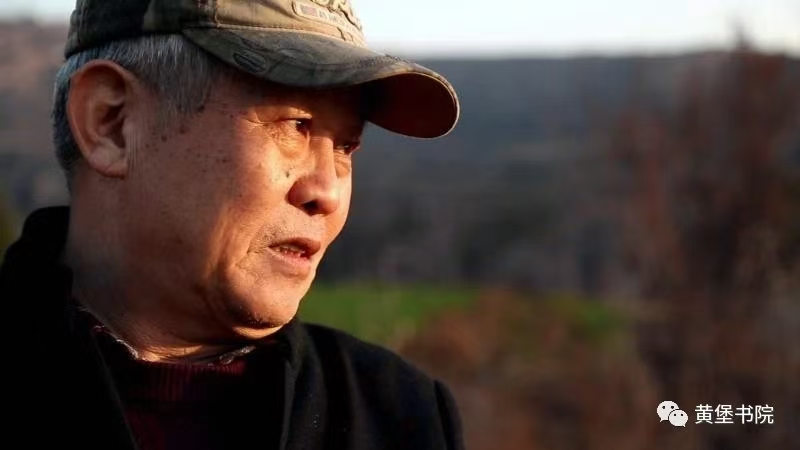
He Gu, born in 1952, from Tongchuan, Shaanxi, graduated from the Chinese Department of Northwest University. He is a Class I literary creator, a member of the Chinese Writers Association, an advisor to the Presidium of the Shaanxi Provincial Writers Association, and the Dean of Huangbao Academy. He is the former Deputy Inspector of the Shaanxi Provincial Federation of Literary and Art Circles. He has won the 4th National Outstanding Reportage Literature Award, the New Era National Outstanding Essay Collection Award, the Feitian Award for Television Dramas, the “Five-One Project” Award, the China Iron Man Literature Award, the Liu Qing Literature Award, the Bingxin Prose Award, and the 2019 China Good Book Award. He has authored over 60 works, including the 20-volume "He Gu Literary Collection." He was the screenwriter for the dance drama "Bai Lu Yuan." His works have been included in textbooks and college entrance examination papers, and have been translated into English, French, and Russian.