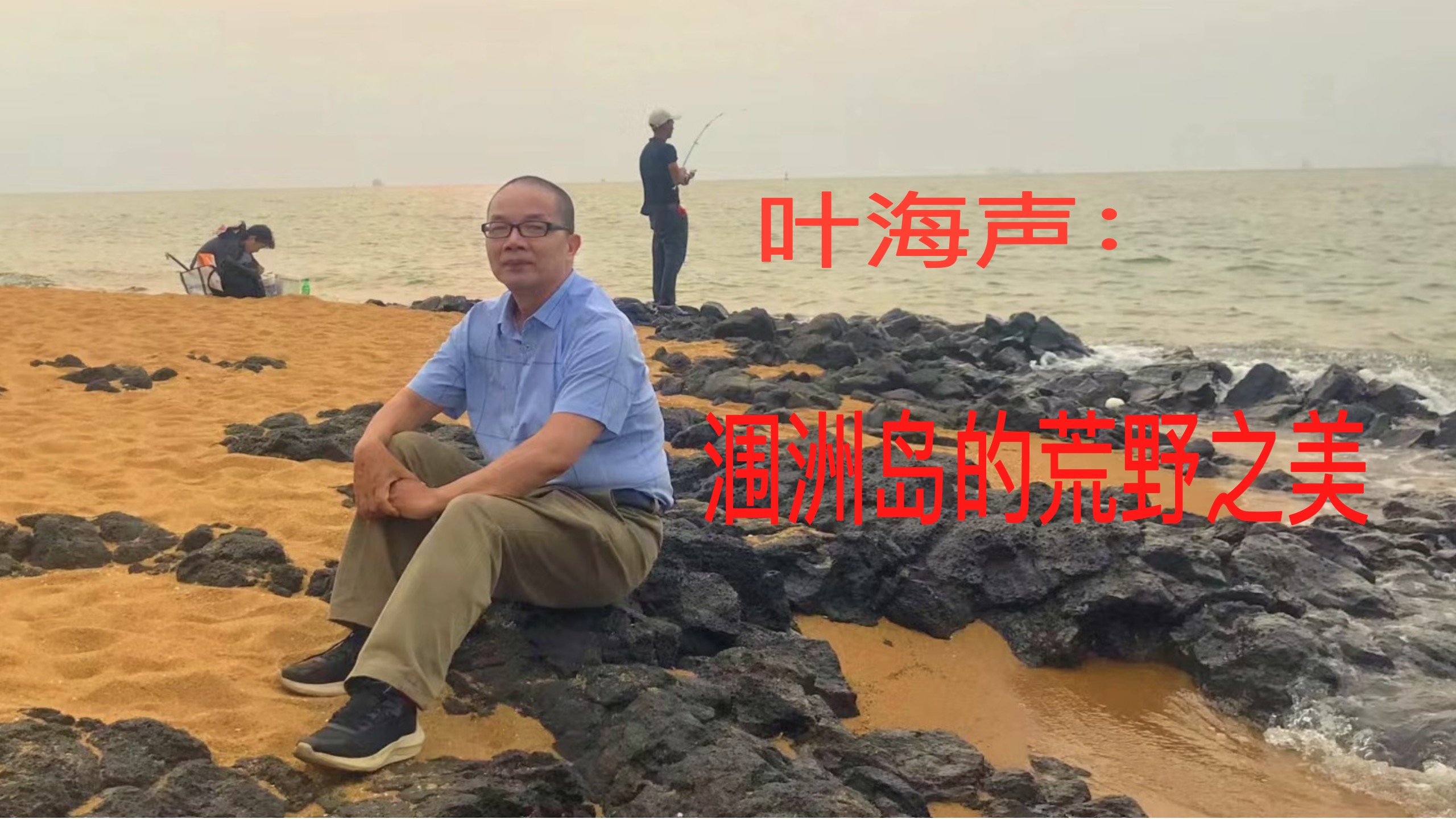
Ye Haisheng: The Wild Beauty of Weizhou Island
Ye Haisheng
1
In the primordial wilderness before the heavens and earth were separated, ferocious beasts roamed and thorns grew in profusion, striking terror into the heart; in modern civilized society, the wilderness is nourishment for our spiritual world. The beauty of the wilderness—serene, majestic, unadorned, wondrous, profound, deep, vast, ethereal—is increasingly rare.
After witnessing too many man-made objects, people experience aesthetic fatigue. The wilderness then complements vision, feeling, and life energy, bringing spring to the desert of the soul.
The spectacle of urbanization is a grand painting, and the beauty of the wilderness is the white space within it.
The wilderness is the “void” in human living space, preventing life from becoming redundant.
Wilderness influences people's state of mind and emotions, evoking feelings of excitement, melancholy, affection, and regret, and reshaping the inner world. In a wilderness alienated from nature, people gradually lose the vast territory of their inner world, and it becomes difficult to have poetic and picturesque feelings again.
The preservation of Weizhou Island's wilderness is deeply significant.
2
No one likes to stay in a place with only concrete buildings. We all like colorful landscapes formed by various plants and animals. Some people particularly love the beauty of the wilderness.
Usually, tourists need to make reservations to visit Weizhou Island, and the number of visitors is limited. People enthusiastically go to the island, probably because they are tired of the mostly monotonous urban buildings and are eagerly embracing the wilderness of Weizhou Island.
The wilderness refers to large areas of land with little human trace, often with lush vegetation, vast and enchanting.
My strong interest in the wilderness began long ago. One day, I was eating breakfast in an open field when it suddenly started to rain. Observing closely, I noticed that most natural things, like rain, leaves, and flowers, are rarely straight; they are mostly curved or close to circular. In contrast, man-made objects, such as the straight edges of fountains, lamp posts, and building corners, are mostly designed in straight lines.
The wilderness is the star of Weizhou Island. Regardless of its color, all wildernesses share one commonality: there are almost no straight lines, only curves spreading throughout.
Compared to the wild, overgrown wilderness, the public bus stop sign on the small road of Weizhou Island, rectangular, small and exquisite, humbly exists in the vast wilderness.
On Weizhou Island, natural elements are the overwhelming majority, and man-made objects are the minority. The buildings on the island are scattered and sparse, with blue bricks, white walls, and red railings. Very few houses exceed three stories, and they are always hidden by green trees and wild grass. Amidst the green shade of bluestone winding paths, among the miscellaneous trees and weeds on both sides of the stone paths, wild pineapples with rounded shapes are occasionally seen.
Weizhou Island strictly prohibits real estate development. The small number of indigenous residents do not harm the wilderness. Fields that could be used for farming are overgrown with wild grass and miscellaneous trees.
3
I got on an electric bike and ventured deep into Weizhou Island. I was a little excited along the way. The jungles along the roadside were dense, and I really wanted to capture the island's scenery with my phone. But I hesitated: the scenery I saw on the island didn't seem much different from what I'd see on the mainland. What justification would I have to prove that what I photographed was different from what I saw on the mainland? In reality, it was very different.
A cow or several cows grazing on a grassy field is also a common sight in rural areas on land. However, on Weizhou Island, a similar scene of a yellow cow or several yellow cows grazing on a grassy field presents an exceptionally vast expanse of wilderness. The color green complements any color, and the image formed by the yellow cows and the wide green fields has a touching effect.
Cattle, perhaps among the happiest residents on Weizhou Island.
4
Weizhou Island doesn't have much rainfall and lacks sufficient water sources. However, with the help of the fertile volcanic soil, wild grass, green trees, star fruit, passion fruit, jackfruit, dragon fruit, papaya, cactus fruit, and more, grow wildly. Vast banana plantations stretch out, their broad leaves, emerald and cool, unafraid of the scorching sun. Bunches of bananas hang upside down from the trees, like open palms reaching out for an embrace. ... The wild beauty of Weizhou Island in Beihai is highlighted because, on this island, curved and rounded lines are the dominant presence.
Weizhou Island exaggerates the wilderness to the extreme, creating a stark contrast with grand buildings, thus achieving an aesthetic effect of contrast.
5
Tens of thousands of years ago, Earth's plates collided, magma erupted for the first time, ever-changing and dreamily drifting. Meanwhile, a basalt foundation was quietly forming on the seabed, laying the groundwork. Later, multiple eruptions occurred, piling stones and dust onto the original foundation, continuously accumulating layer upon layer, growing higher and higher. After tens of thousands of years, the undersea volcanic activity subsided. Subsequently, volcanic activity resumed for a second phase. During this eruption, shockwaves pierced the sky, magma roared, surging towards the heavens, and fierce flames consumed all living things, causing widespread devastation. When the eruption ended, seasons changed and years passed. Gradually, an almost circular island, Weizhou Island, was formed, with a broad and solid platform on its wild land.
6
The attractions on Weizhou Island's South Bay West Side include Crocodile Ridge, the lighthouse, Tangweng Terrace, the old crater site, Tian Gong Tan Qi, Turtle Hiding Cave, Bandit Cave, Ten Thousand Beasts Making a Ruckus, sea-eroded cable-stayed bridge, Moon Bay, coral bush sedimentary rocks, Sea Drying Stone Ruins, and numerous other caves. There are also geological wonders such as volcanic bomb impact craters, ancient tree fossils, Flower and Fruit Mountain's Water Curtain Cave, sea stacks, and sea-eroded mounds... Nature's masterpiece is bizarre and unique, with no piece presenting itself in straight horizontal and vertical lines like man-made buildings.
The vast majority of scenes depicted in Tang and Song poetry describe the natural ecosystem, and therefore are full of curves, such as vast expanses of emerald green, flowing water and wisps of cooking smoke, withered vines, old trees, and crows at dusk.
Straight lines are most conducive to extension and expansion, which is why man-made cities are filled with straight lines everywhere. Even the flashing neon lights at night often appear as straight horizontal and vertical lines.
The occasional climbing vine on the wall is a natural element adorning something man-made.
7
Man-made objects and nature, straight and curved lines, often complement each other. This complementarity is just right for the best.
With the help of nature's hand, it's no wonder that “dripping water through stone” or “water wears stone round.”
The Earth is round, and Weizhou Island is also generally round. Many of the stones on Weizhou Island were originally sharp, but after enduring the grinding of time, wind, and rain, they have all become rounded.
Crocodile Mountain was formed by volcanic eruptions, resulting in the most volcanic geological landscape. Lush green trees and vibrant flowers adorn the area. Between these sights, a newly constructed wooden walkway curves gracefully into the distance.
Weizhou Island's Nanwan is like an oval courtyard, a bay enclosed by horseshoe-shaped volcanic rocks, with pale blue water and a wide surface. Weizhou Island and Nanwan together resemble a green-handled ladle, floating on the vast, misty sea. Wilderness and water connect, bringing it to life.
The pier harmoniously combines man-made elements with nature. Over a thousand meters of wooden boardwalk, small bridges paved with wooden planks meander over the coastal rocks, extending continuously, allowing people to peacefully coexist with nature.
Circles and squares, the combination of curves and straight lines, nature and humans mutually assisting each other. When people display their strength, they must rely on the power of nature. Without round wheels, cars would be difficult to drive. Without the arrangement of straight lines, the plank roads of steep mountains and ridges, bridges connecting this shore and that shore, and the construction of buildings would be impossible. There is a question: nature can exist without humans, but humans cannot do without nature.
When people strive to surge forward, they often turn to round objects for acceleration, such as money (coins or ingots), spheres, wheels, and bullets. The roundness of various balls, neither too big nor too small, captivates people worldwide with their games, yet these games are harmless and do not cost lives. — For a long time, people have been eager for quick success and forget righteousness when seeing profit, and when impulsive, the consequences can be dire. However, at times, they are always able to find ways and means to avoid harm, using ball games to circumvent war.
8
Weizhou Island is also a museum of colors. In nature, the colors of things like clouds, sunrise, and sunset do not usually appear as harsh, straight lines.
Weizhou Island is covered in natural landscapes. The sheer variety of trees (tall and short, dense and sparse, with varying leaf colors), the abundance of flowers, vast banana groves, wild grasses that resemble seedlings, purplish-black stones, pitted and uneven terrain, dry red soil mixed with stones of various sizes, and colors like rust red, ink black, palace tile blue, emerald green, coarse vat white, grape purple, and pomelo yellow, make it more than just multi-colored... The primary color of the wilderness is inherently green or dark brown, but this doesn't prevent it from blending with a multitude of colors, nor does it hinder the harmonious integration of curved lines. The grasslands of Inner Mongolia, the Gobi Desert of the Northwest, and the Zhangye Colorful Danxia in Gansu are all wild landscapes where colors and lines are beautifully composed.
The accumulation of time on Weizhou Island is not only reflected in the written explanations and later architecture, but is more embodied in the shapes and colors of the scenery itself. Looking around, liver-colored lava, eroded by the salty seawater, has formed a multitude of peculiar landforms such as sea caves, sea cliffs, sea platforms, sea windows, and sea mushrooms, all of which show the shaping power of the passage of time.
Upon arriving at the volcanic island's coast, there's very little sand underfoot. Red or purplish-black stones lie unevenly, some submerged in the sea, others jutting out into the ocean. On the pitted rocks, there are also stones of various shapes and sizes; some are round, some are long, some are piled on top of each other, some are pressed against each other, in all sorts of shapes, but not a straight line is to be seen.
The sea-eroded platform, extending from the base of the mountain roots towards the ocean, is wide. At low tide, its width exceeds one hundred meters. Such sea-eroded landscapes are rare along China's coast, and here they are large, typical, complete, and concentrated. Weizhou Island offers other spectacular masterpieces.
The sea constantly crashes, and when the tide recedes, the flat stone slabs are filled with pits and hollows, with columns and craters. Some are filled with water and covered in moss, appearing clear and serene yet brilliantly colorful, like a dream. The stones of Colorful Beach are already rich in color, and with the reflection of the morning and evening sun and sunset, they become even more magnificent and dazzling, creating a natural and wild seascape.
9
When straight lines cut through the natural environment, they inevitably cause varying degrees of damage to the natural world. Adding some curved elements among man-made objects might be a subconscious expression of guilt towards nature, or it might add natural elements to the monotony and dullness of man-made objects.
The hotel we are staying at is the Vanly Weizhou Island Secret Realm Art Museum Hotel. I spoke of the mystery of composing man-made objects with natural objects. Since a hotel is a man-made object, straight lines are absolutely dominant. The owner specifically installed many flickering oil lamps in the hotel corridors. These lamps were introduced from Thailand and are called Thai torches; they do not go out even in wind and rain. The Thai torches are intentionally designed to create curved, graceful lines.
The decorative lights on the hotel walls, including the fountain, were initially intended to be presented in straight lines. However, after they burst forth, flowed, or slid, they also took on curved shapes. As the saying goes, the benevolent delight in mountains, while the wise delight in water. Regardless of whether it's mountains or water, their shapes rarely charge headlong. The hotel corridors displayed several circular urns or jars. I suspect the hotel owner, intentionally or unintentionally, used the curves of the lights and the urns to soften the starkness of the hotel's straight and horizontal lines. The television in the hotel lobby repeatedly showed natural scenery from Weizhou Island, aiming to achieve as much harmony between people and nature as possible, and to rediscover the beauty of the wilderness.
10
Weizhou Island originally had no plants or animals. All life, plants, animals, and people, came from outside.
Birds fly from the sea, imagine those migratory birds, drawing countless arcs across the blue sky before winter, arriving at Weizhou Island.
The plants on the cliff are gradually turning green like dragons, with cacti being the most conspicuous. According to the guide, some cacti grow on cliffs because migratory birds, while perching on the cliffs, defecated the fruits of cacti they ate elsewhere. Later, the cactus fruits took root and sprouted, demonstrating their tenacity, thus leading to the cacti on the cliffs.
Some plant seeds are blown by the wind or carried by ocean waves, and others are brought by fishing boats. Many years ago, fishermen discovered this island and began to live there. Since there were no materials on the island to build houses, they shipped bamboo and other things from elsewhere by boat. This also brought green tree snakes, butterflies, dragonflies, bees, and ants, with uncertain consequences.
Between some trees, occasionally, one sees large and sturdy spiderwebs, one after another. Within the mesh, one can finally discern short straight lines, but these short lines, when combined, form a circular net. One large black creature after another lies motionless in the web, guarding its territory solemnly like sentinels, patiently waiting for prey that walks into the trap.
The wilderness of Weizhou Island is no longer monotonous.
11
People often simulate “natural things,” allowing natural and artificial things to complement each other.
That afternoon, I sat on a coral stone, the shadows on the sand growing longer as the sun descended, the sound of the waves lapping the shore unchanged. A feeling of profound realization struck me: there are virtually no straight lines in the human body; humans are inherently a part of nature.
When people try to enjoy or conquer nature, they invent or build many straight things, such as lighthouses, ships, cars, and bridges. For man-made objects to fit with natural objects, they must have a curved appearance. Big ships and small ships must resemble fish, and big cars and small cars must somewhat look like beetles.
Among man-made objects, those that imitate natural landscapes tend to be particularly eye-catching. Examples include arched bridges, the “Beibu Bay No. 1” in Beihai that mimics the scenery of Guilin, and the shell-shaped buildings and tree-shaped row houses on Sanya's Phoenix Island. These structures, by departing from the familiar straight-line, grid-like architectural styles, have become unique landmarks. Any television program featuring Sanya seems obliged to include them as visually striking curiosities.
Haikou Bay's curved Cloud Cave Library is so appealing precisely because Haikou's streets are lined with buildings that are straight and horizontal, perhaps because such buildings are larger in usable area and lower in cost. Buildings in Sanya, Haikou, and other places that imitate natural objects, without even mentioning cost, take more thought to construct.
Weizhou Island needs to imitate nothing, nor is it easily imitated.
12
A lively life should also have a wilderness. The most beautiful sedimentation and even creation are usually completed in the wilderness. Sometimes we should be grateful to those who let your life go to ruin.
Visited Weizhou Island at the end of July. It was hot and I was drenched in sweat, but I had an epiphany. I'll write it down. Gratitude.

Introduction: Ye Haisheng, a writer, has worked as a journalist, editor, translator, international seaman, and English teacher at middle and high schools and universities. He is a graduate of the ninth advanced study class at the Lu Xun Academy of Literature and Art. He has published essay collections such as “Thoughts of a Thinker” and "A Cold Look at Confucius," a novel and essay collection titled "The Worldly Life," and authored and compiled "Appraising Hainanese People." He has published essays, critical essays, and short stories in the "Yangcheng Evening News," and serialized the novel "The Pirate Ship" in the same publication. He served as a screenwriter for Hainan Television's "Green Island Home." He was formerly the Vice Chairman of the Haikou Writers Association and is currently an advisor to the Haikou Writers Association. He has previously worked for the feature section of the "Nanguo Metropolis Daily" and the Hainan International Communication Center.