
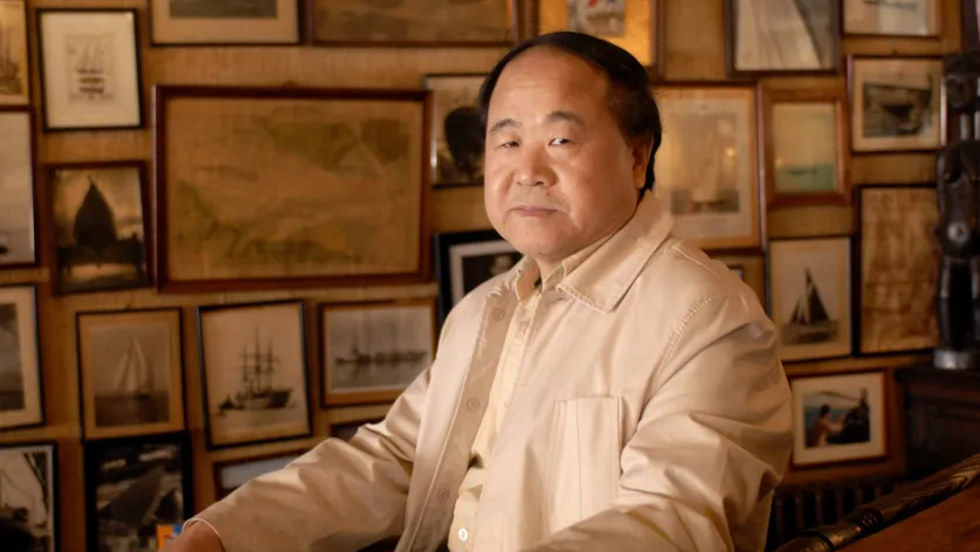
Mo Yan's Nobel Prize in Literature Acceptance Speech: "The Storyteller"
Source:China News Service
Esteemed Members of the Swedish Academy, Ladies and Gentlemen:
Through television or the internet, I believe everyone present has gained some understanding of the distant Gao Mi Northeast Township. You may have seen my ninety-year-old father, my siblings, my wife and daughters, and my one-year-and-four-month-old grandson. However, there is one person I miss most at this moment, my mother, whom you will never see. After I received this award, many people shared my glory with me, but my mother can no longer share it.
My mother was born in 1922 and passed away in 1994. Her ashes were buried in the peach orchard east of the village. Last year, a railway had to pass through there, and we had to move her grave to a place further from the village. After excavating the grave, we saw that the coffin had rotted away, and my mother's bones had already become one with the earth. We could only symbolically scoop up some soil and move it to the new burial site. It was from that moment on that I felt my mother was part of the earth, and my words spoken while standing on the earth were words spoken to my mother.
I am my mother's youngest child.
The earliest memory I have is carrying our only thermos to the public mess hall to get hot water. Because I was hungry and weak, I accidentally dropped and broke the thermos. I was terrified and hid in a haystack, not daring to come out all day. In the evening, I heard my mother calling my childhood nickname. I crawled out of the haystack, expecting to be scolded or punished, but my mother didn't hit me or yell at me. She just stroked my head and let out a long sigh.
The most painful memory I have is going with my mother to glean fallen wheat ears from collective fields. A guard came, and everyone gleaning scattered and fled. My mother, with her bound feet, couldn't run fast. She was caught, and the tall guard slapped her. She stumbled and fell to the ground. The guard confiscated the wheat ears we had gathered and swaggered away, whistling. My mother, bleeding from the mouth, sat on the ground, her look of despair forever etched in my memory. Years later, when that wheat field guard, now a white-haired old man, encountered me in the marketplace, I rushed forward wanting revenge. My mother stopped me and calmly said, “Son, the man who hit me and this old man are not the same person.”
The most memorable thing for me was one Mid-Autumn Festival at noon, when our family rarely made dumplings, and each person only got one bowl. Just as we were eating dumplings, an old beggar came to our door. I picked up half a bowl of dried sweet potatoes to send him away, but he said indignantly, “I'm an old man, you eat dumplings, but you make me eat dried sweet potatoes. What are your hearts made of?” I said furiously, “We don't eat dumplings more than a few times a year, and each person only gets a small bowl, not even enough to be half full! It's good enough that I'm giving you dried sweet potatoes. If you want them, take them, if not, get out!” My mother scolded me, then picked up her half bowl of dumplings and poured them into the old man's bowl.
The thing I regret most is going with my mother to sell cabbage and intentionally or unintentionally overcharging an elderly customer an extra dime. After I finished the transaction, I went to school. When I returned home from school, I saw my mother, who rarely cried, weeping. My mother didn't scold me; she just gently said, “Son, you've shamed me.”
When I was a teenager, my mother fell seriously ill with lung disease. Hunger, sickness, and exhaustion plunged our family into hardship, leaving us with no light or hope. I developed a strong premonition that my mother might take her own life at any moment. Every time I returned from work, I would call out for my mother as soon as I entered the door, and only when I heard her reply would I feel a weight lifted from my heart. If I couldn't hear her respond for a while, I would be filled with dread and rush to the kitchen and mill to search for her. One time, after searching all the rooms and not finding her, I sat down in the courtyard and cried. Just then, my mother walked in carrying a bundle of firewood. She was displeased with my crying, but I couldn't voice my anxieties to her. Seeing my thoughts, my mother said, “Child, don't worry. Although my life holds no joy, as long as the King of Hell doesn't call me, I won't go.”
I was born with an ugly appearance. Many people in the village openly mocked me, and a few aggressive classmates at school even beat me because of it. Returning home, I cried bitterly. My mother said to me, “Son, you are not ugly. You have a nose and eyes, and your limbs are sound. Where is the ugliness? Moreover, as long as you have a kind heart and do good deeds, even ugliness can become beauty.” Later, I moved to the city. Some cultured people still mocked my appearance behind my back and even to my face. I remembered my mother's words and calmly apologized to them.
My mother is illiterate, yet she deeply respects those who are literate. Our family lived in poverty, and we often didn't know where our next meal would come from. But whenever I asked her to buy books or stationery, she always fulfilled my requests. She is a hardworking person and dislikes lazy children, but she never criticized me when I fell behind on chores because I was reading.
For a while, a storyteller came to the market. I secretly ran off to listen to stories, forgetting the chores she assigned me. For this, my mother criticized me. That night, as she sewed cotton clothes for the family by the light of a small oil lamp, I couldn't help but retell the stories I had heard from the storyteller during the day. At first, she was a bit impatient because in her mind, storytellers were glib, idle people who didn't say anything good. But the stories I retold gradually captivated her. From then on, every market day, she no longer assigned me chores and tacitly allowed me to go to the market to listen to stories. To repay my mother's kindness and to show off my memory to her, I would tell her the stories I heard during the day vividly and colorfully.
Soon, I was no longer content to retell the stories the storytellers told. I constantly embellished them as I retold them, tailoring the plots to my mother's liking, sometimes even changing the endings. My audience was no longer just my mother; my older sister, my aunt, and my grandmother all became listeners. After hearing my stories, my mother would sometimes worry and say, as if to me, or perhaps to herself, “My son, what kind of person will you be when you grow up? Will you earn your living by talking nonsense?”
I understand my mother's concerns because in the village, a glib child is annoying and can sometimes cause trouble for themselves and their family. The child I wrote about in my novel "Cattle" who was disliked by the village for talking too much, carries a shadow of my childhood. My mother often reminded me to speak less, hoping I would be a quiet, steady, and dignified child. However, I exhibited a strong ability and desire to speak, which was undoubtedly a great danger. Yet, my ability to tell stories brought her joy, which plunged her into deep conflict.
As the saying goes, “It's easier to change a country's rivers and mountains than a person's nature.” Despite my parents“ earnest teachings, I haven't changed my talkative nature, which makes my name, ”Mo Yan" (meaning "don't speak"), somewhat ironic.
I dropped out of school before finishing elementary school. Because I was young and frail, I couldn't do heavy labor, so I had to herd cattle and sheep in the overgrown fields. When I led the cattle and sheep past the school gate, seeing my former classmates playing and laughing on campus filled me with sorrow. I deeply felt the pain of being separated from the group, even for a child.
When we arrived at the wilderness, I let the cattle and sheep graze freely. The blue sky was like the sea, and the grassland stretched as far as the eye could see. I couldn't see a single person or hear any human sounds. The only sound was the chirping of birds in the sky. I felt very lonely and empty. Sometimes, I would lie on the grass, watching the lazy white clouds drift across the sky, and all sorts of inexplicable illusions would appear in my mind. Many stories circulate in our region about foxes transforming into beautiful women. I fantasized about a fox transforming into a beauty to keep me company while I herded the cattle, but she never appeared. However, one time, when a fiery red fox leaped out of the grass in front of me, I was so startled that I fell to the ground. The fox disappeared without a trace, and I was still trembling there. Sometimes I would squat beside a cow, looking at its deep blue eyes and seeing my reflection in them. Sometimes I would try to imitate the calls of birds to communicate with them, and sometimes I would confide in a tree. But neither the birds nor the tree paid me any attention. Many years later, when I became a novelist, many of the fantasies from that time were incorporated into my writings. Many people praised my rich imagination, and some literary enthusiasts hoped I could share my secret for cultivating imagination. To them, I could only offer a wry smile.
As the ancient Chinese sage Lao Tzu said, “Good fortune implies hidden misfortune, and misfortune implies hidden good fortune.” I dropped out of school in my childhood and suffered from hunger, loneliness, and a lack of books to read. However, because of this, like our predecessor writer Shen Congwen, I began to read the great book of society and life early on. The aforementioned listening to storytellers at the market is merely one page in this great book.
After dropping out of school, I mingled with adults and began a long journey of “reading with my ears.” More than two hundred years ago, my hometown produced a great genius storyteller – Pu Songling, and many people in my village, including myself, were his inheritors. I listened to countless tales of gods and ghosts, historical legends, and anecdotes in the fields during collective labor, in the cow sheds and horse stables of the production team, on the warm kang beds of my grandparents, and even on rocking ox carts. These stories were closely connected to the local natural environment and family history, giving me a strong sense of reality.
I never dreamed these things would become my writing material. I was just a child fascinated by stories, enraptured by people's tales. Back then, I was an absolute animist, believing that everything had a spirit. I would feel awe when I saw a large tree. I would look at a bird and feel it could transform into a human at any moment. When I met a stranger, I would also suspect they were an animal in disguise. Every night, when I ran home from the production team's accounting office, boundless fear would envelop me. To bolster my courage, I would run and sing loudly. I was going through puberty then, my voice hoarse and unpleasant, and my singing was a torment to my fellow villagers.
I lived in my hometown for twenty-one years, and the furthest I ever went from home was a train trip to Qingdao. I almost got lost among the huge logs in the lumberyard, so much so that when my mother asked what scenery I saw in Qingdao, I dejectedly told her: "I didn't see anything, just piles and piles of wood." But it was precisely this trip to Qingdao that sparked a strong desire in me to leave my hometown and see the world.
In February 1976, I enlisted in the army. Carrying the four volumes of "Abridged General History of China" that my mother sold her wedding jewelry to buy for me, I left Gaomi Northeast Township, a place I both loved and hated, and embarked on an important period of my life. I must admit that without the tremendous development and progress of Chinese society over the past 30-plus years, and without the reform and opening up, there would be no writer like me.
Amidst the monotonous life in the barracks, I encountered the ideological emancipation and literary fervor of the 1980s. I transformed from a child who listened to stories with my ears and told them with my mouth to someone who began to tell stories with a pen. The path was not smooth at first. I didn't realize then that my twenty-plus years of rural life experience were a rich vein for literature. At that time, I thought literature was about writing about good people doing good deeds, about writing about heroes and role models. Therefore, despite publishing a few works, their literary value was very low.
In the autumn of 1984, I was admitted to the Literature Department of the People's Liberation Army Academy of Arts. Under the inspiration and guidance of my esteemed teacher, the renowned writer Xu Wozhong, I wrote a series of novellas and short stories, including “Autumn Water,” “Withered River,” “The Transparent Carrot,” and "Red Sorghum." The term "Gao Mi Northeast Township" first appeared in my novella "Autumn Water." From then on, just as a wandering peasant found his land, I, a literary wanderer, finally found a place to settle and root myself. I must admit that the American William Faulkner and the Colombian Gabriel García Márquez provided me with significant inspiration in creating my literary territory, "Gao Mi Northeast Township." I did not read them diligently, but their groundbreaking and heroic spirit inspired me, making me understand that a writer must have a place of their own. One should be humble and yielding in daily life, but in literary creation, one must be imperious and dictatorial. I followed in the footsteps of these two masters for two years, and then realized that I had to escape them as quickly as possible. I wrote in an essay: They are two scorching stoves, and I am an ice cube; if I stay too close to them, I will be evaporated. From my experience, the fundamental reason why a writer is influenced by another writer is the similarity between the souls of the influencer and the influenced. As the saying goes, "Spiritual connection makes hearts understand." Therefore, even though I didn't read their books thoroughly, after just a few pages, I understood what they had done, how they had done it, and consequently, I understood what I should do and how I should do it.
What I do is actually very simple: tell my own stories in my own way. My way is the way of the marketplace storytellers I know well, the way my grandparents and the elders in the village told stories. Frankly, when I was telling them, I didn't think about who my audience would be. Perhaps my audience would be people like my mother, perhaps my audience would be myself. My own stories were initially my personal experiences, for example, the child who was beaten in "The Withered River," or the child who remained silent from beginning to end in "The Transparent Carrot." I was indeed severely beaten by my father for a mistake I made, and I did indeed pump the bellows for the blacksmith on a bridge construction site. Of course, no personal experience, however peculiar, can be written into a novel whole. Novels must be fictionalized, must imagine. Many friends say "The Transparent Carrot" is my best novel. I neither refute nor agree, but I think "The Transparent Carrot" is the most symbolic and profound work among my writings. That child, completely black, possessing superhuman endurance of pain and superhuman sensitivity, is the soul of all my novels. Although I have written many characters in later novels, none of them are closer to my soul than he is. Or one could say, among the many characters an author creates, there is always a leader. This silent child is such a leader. He remains silent, yet powerfully leads all sorts of characters in their performances on the stage of Gaomi Northeast Township.
One's own story is always limited. When one has finished telling their own story, they must then tell the stories of others. And so, the stories of my relatives, the stories of my fellow villagers, and the stories of my ancestors, heard from the mouths of the elders, surged forth from the depths of my memory like soldiers answering a roll call. They looked at me with expectant eyes, waiting for me to write about them. My grandfather, grandmother, father, mother, brother, sister, aunt, uncle, wife, and daughter have all appeared in my works, as have many of the villagers from our Dongbei township in Gaomi. Of course, I gave them all literary treatment, allowing them to transcend their own selves and become characters in literature.