
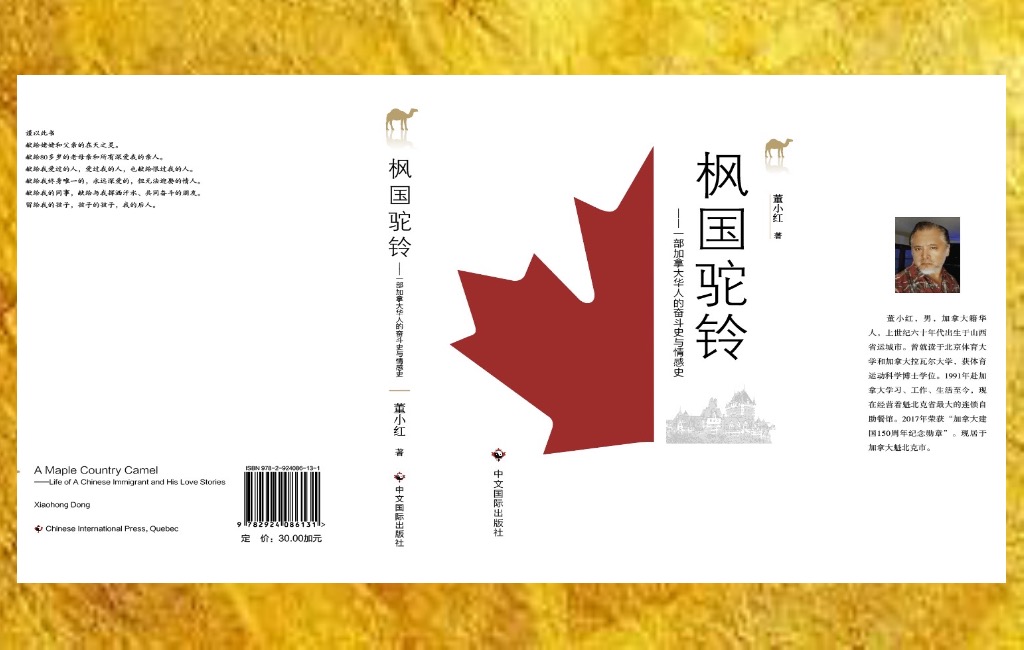
Author Pang Jin's Book Review of Dong Xiaohong's "Camel Bells of Maple Country": A Colorful Display of Complex Human Nature
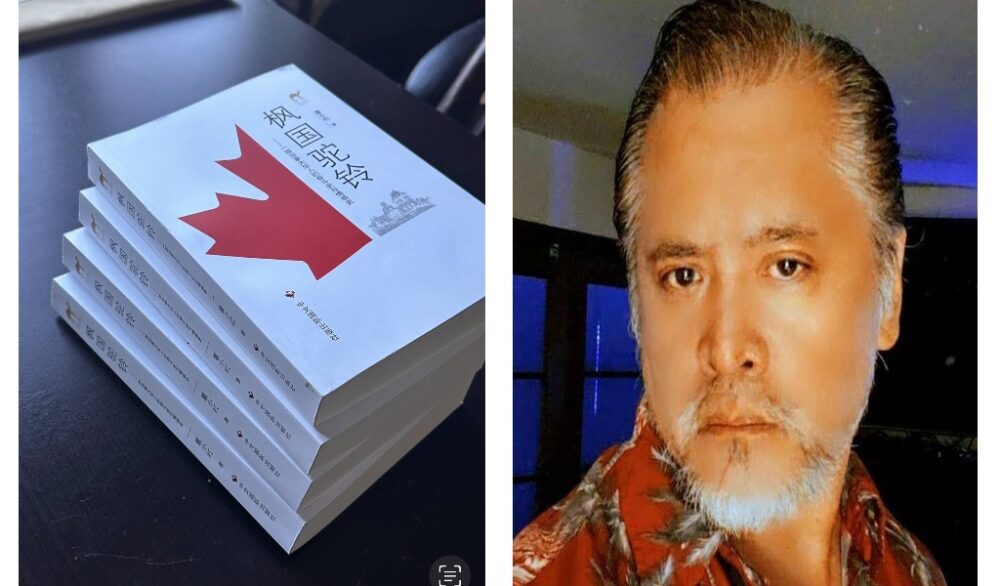
Editor's Note: Chinese in QuebecWriter Dong Xiaohong, male, is a Chinese Canadian born in Yuncheng City, Shanxi Province in the 1960s. He studied at Beijing Sport University and Laval University in Canada, where he earned a Ph.D. in Sports Science.1991Have studied, worked, and lived in Canada since [year], and now operate the largest chain of buffet restaurants in Quebec.2017Order of Canada150Anniversary Medal.” She currently resides in Quebec City, Canada. Dong Xiaohong, with her painstaking efforts and accumulated experience, created a 50The lengthy novel, "Camel Bells of Maple Land," with its multitudinous characters and chapters, has been published by Chinese International Press. This book is a rare and excellent work in recent years, a joyous achievement of Canadian literary creation, and it adds a significant stroke to the canvas of overseas Chinese literary circles! Yan Fei, president of the Canadian Chinese Writers Association, highly recommends "Camel Bells of Maple Land," and writer Pang Jin has written a book review for it, titled "A Colorful Display of Complex Human Nature."。
A colorful display of complex human nature
——Reading Dong Xiaohong's "Canadian Camel Bells: A History of Chinese Canadians' Struggles and Emotions"
Pang Jin
Yan Fei, president of the Canadian Chinese Writers Association, recommended Mr. Dong Xiaohong's autobiographical novel "Maple Country Camel Bells - A History of Struggle and Emotion of Chinese Canadians." I immediately set aside what I was doing and spent six days reading this massive work of over 500,000 characters from beginning to end, without skipping a single word.
The process of reading is being captivated by the author's colorful story. After reading, there are two strong feelings to savor: First, a boss who studied sports, obtained a doctorate degree, yet made a living by operating a chain of buffet restaurants, possesses such excellent literary skills, comparable to professional Chinese literature practitioners, and a writing ability that ordinary writers may not reach. Second, the book profoundly and vividly displays complex and multifaceted human nature through the protagonist's career struggles and emotional journey. Some plots and details are so bold, open, and brilliant that they can stir the reader's heart.
Human nature can be briefly understood as the essential attributes of a person. What are the essential attributes of a person? First and foremost, humans exist as animals, so the essential attribute of humanity is animality. What is animality? Eating and mating: eating to sustain life, and mating to propagate life. Secondly, humans are beings who transcend ordinary animals, thus the essential attributes of humans include those that transcend ordinary animals. Their primary components are rationality, physiologically supported by a developed thinking organ, and sociality, as beings who exist in groups. This rationality and sociality give rise to morality, law, customs, language, aesthetics, and other aspects of human society. They also prevent humans from completely and utterly behaving like any non-human animal when fulfilling their animalistic drives.
Thus, complex human nature involves several sets of contradictory relationships that interpenetrate and intertwine: desire and love (desire is a direct manifestation of animal nature, while love integrates desire, emotion, rationality, and sociality); desire, love, and marriage/family (marriage and family are important manifestations of sociality, moderating or even restraining desire and love); desire, love, marriage, family, and career (career reflects an individual's social value and often has a balancing conflict with family and love); desire, love, marriage, family, career, and society (society bestows rules and responsibilities on individuals, forming a larger web that incorporates individual behavior into group order).
These sets of contradictory relationships, like an all-encompassing net of heaven, envelop everyone from ancient times to the present, that is, men and women from antiquity to today. Whether they are high officials and distinguished personages or ordinary people, no one lives, strives, explores, creates, struggles, suffers, rejoices, excels, is awful, feels bored and helpless, or escapes without being caught in the net formed by these contradictory relationships. The only difference lies in the specific forms and varying degrees of intensity.
The protagonist of “Camel Bells of Maple Country,” Gao Yuan, has a rich and colorful life journey that undoubtedly serves as a vivid interpretation of the aforementioned contradictory relationships, truly “showing” and “explaining.” Solely in terms of romantic relationships: at sixteen, he had physical contact with a sports school girl on a train; during a university break, he “stole a forbidden fruit” with his childhood sweetheart in his father's office; after getting married and having children, he, unbeknownst to his wife, indulged in wild revelry with his mistress in cars and hotel rooms; after divorcing and becoming single, in Toronto, Beijing, and Singapore, “he traveled all over the world in just two or three short years, dating over a dozen girlfriends and taking many intimate photos,” even engaging in sexual intercourse in an airplane restroom thousands of feet in the air.
“Even though in his heart, Gao Yuan repeatedly told himself ‘no, no,’ he said that he and Cheng Jing were just ordinary friends. Although Cheng Jing was alone, she actually had a husband – her ‘fake divorce” with her husband was just that, a fake divorce. They still deeply loved each other. Although he had also dreamed of being intimate with Cheng Jing, dreams are ultimately just dreams. The reality was that he absolutely could not take advantage of her vulnerability. However, while thinking this, his hand still reached into Cheng Jing's nightgown. He was the tree, Cheng Jing was the vine; he was the fish, Cheng Jing was the seawater; he was the flame, Cheng Jing was dry firewood; he was a nutrient-rich pillar of water, Cheng Jing was a moist river mussel; he was the prey, Cheng Jing was the hunter; or he was the hunter, Cheng Jing was the prey... Cheng Jing began to moan, her passionate and soul-stirring sounds ultimately made Gao Yuan unable to refuse and unwilling to refuse...”
This passage describes the adulterous affair and the conflicting emotions of the adulterer with great accuracy and vividness. In the book “Camel Bells of Maple Country,” such "accuracy and vividness" can be found in many other places.
How to face, reconcile, and handle the aforementioned contradictions of complex human nature? It varies from person to person, time to time, and situation to situation. Of course, there is also the issue of “degree.” When reconciliation and handling are done appropriately, one can “stand at the forefront with banners flying” or “a light boat can pass through ten thousand mountains.” If done inappropriately, it often leads to “broken masts and capsized ships,” or even “people becoming fish and turtles.” In this regard, ancient Chinese wisdom offers teachings or principles such as “following one's heart's desire without transgressing boundaries” and "reaching the highest and following the middle way." Challenging or going against such teachings and principles will inevitably lead to punishment and cost. In the book "Camel Bells of Maple Country," the protagonist Gao Yuan, during his university days, was found to have stayed too late in the women's dormitory due to his indulgence with his girlfriend, violating school rules and facing expulsion. This led his father, a revolutionary who was a local leader, to specially travel to the capital, humbling himself to plead with the school authorities, pull strings, and seek favors. Gao Yuan himself, "humble and subservient," approached the university leadership, "kneeling from one office to another. That day, he knelt his self-respect and pride into pieces."
At the end of this book review, the author logged onto the Facebook page of Dong Xiaohong, the author of "Camel Bells in Maple Country," and saw the following passage:
“Maintaining a marriage is harder than founding and running a great global company! It's harder than leading a country! You can be a great king, a great president, or even a scientist who changes the destiny of mankind, but you can't manage a marriage. Why? Because marriage is not suited to human nature; it's a heavy burden imposed by civilized society on humans who haven't fully shed their animalistic instincts!!! It's especially not suited to wealthy people.”
Friend, what do you think of this passage?
(December 30, 2024, at Maple Leaf Pavilion, Canada)

Author Biography: Pang Jin, expert in Dragon and Phoenix culture, writer. Chairman of the Dragon and Phoenix International Federation, Honorary Chairman of the Chinese Dragon Culture Association, Director of the Chinese Dragon and Phoenix Culture Research Center, Senior Editor of Xi'an Daily. Member of the Chinese Writers Association, Director of the Shaanxi Provincial Writers Association, Visiting Researcher of the Shaanxi Provincial Academy of Social Sciences, Chief Editor of the Chinese Dragon and Phoenix Culture Network (www.loongfeng.org), Director of the Chinese Canadian Writers Association, and Deputy Chief Editor of Canada Xi'an Ontario Publishing House. He studied at Shaanxi Normal University and Northwest University, holding a Bachelor of Philosophy and a Master of Literature. Since the 1970s, he has been engaged in literary creation and cultural research, publishing over ten million characters of various works to date. He has published fifty-five books, including “Theory of Creation,” "Chinese Dragon Culture" (Volumes I, II, and III), "Chinese Phoenix Culture," "Chinese Auspiciousness," "Dancing Spirit Trees," "Generations of Commoners," and "Pang Jin's Collected Works" (Volumes 1-20). He has received over eighty awards, including the first Chinese Bing Xin Prose Award, the first Shaanxi Folk Art Mountain Flower Award, and the first prize for outstanding achievements in social sciences in Xi'an. He is honored as one of the "Top Ten Contemporary Figures in Dragon Culture." WeChat ID: pang_jin


