
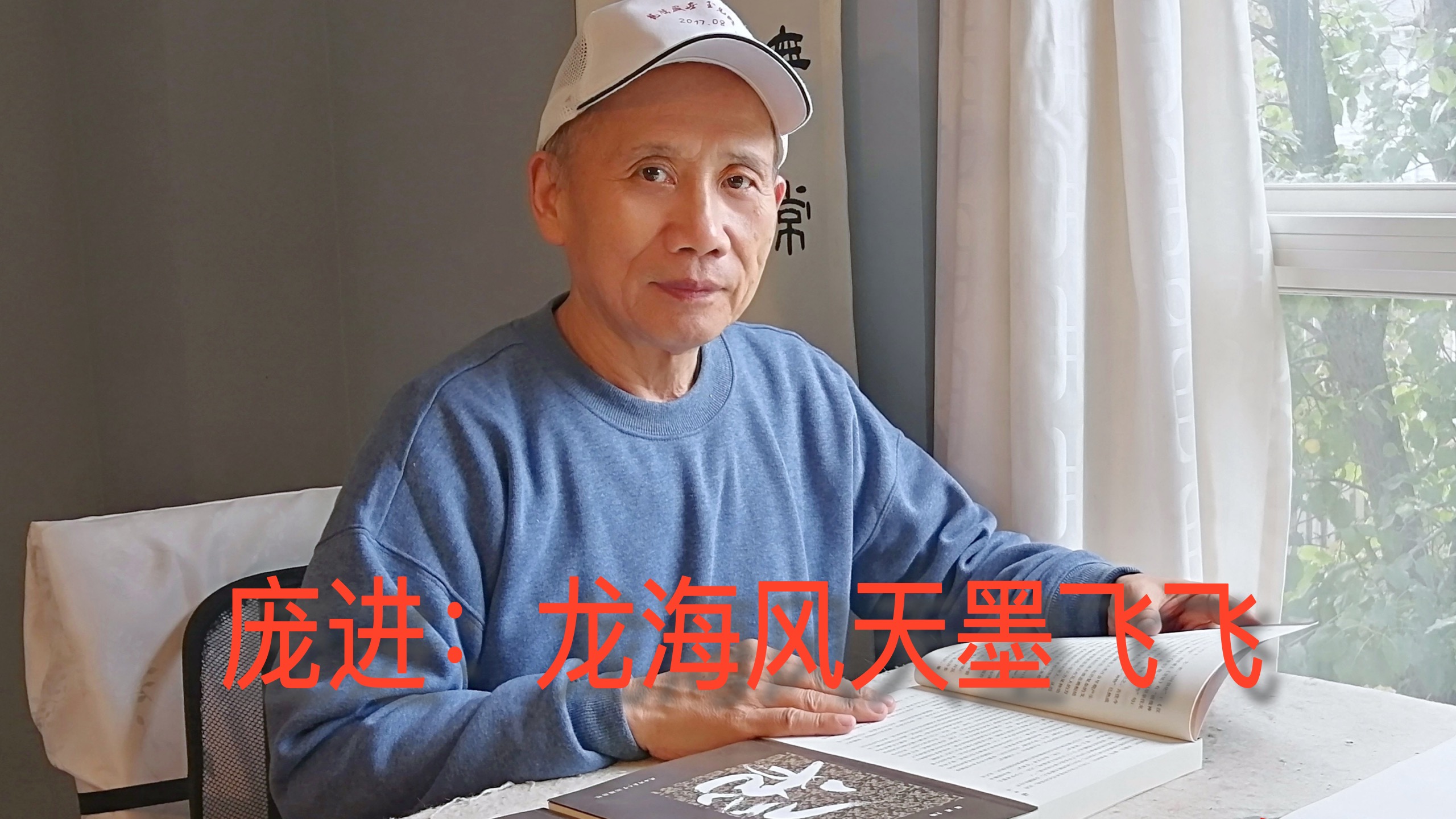
Pang Jin: Long Hai Feng Tian Mo Fei Fei
Pang Jin
Several times people have asked, “Teacher Pang, your handwriting is so beautiful. When did you start practicing?” I often reply, not very modestly, “This is my skill from childhood!” I wasn't lying. Looking back, my fundamental calligraphy skills were laid down in the 1960s when I was in primary school. I was around ten years old then. My academic performance was at the top of the class, even the whole school. I was the class monitor and had honors like “Three Good Student” and “Active Builder of Mao Zedong Thought.” My homeroom teacher assigned me the task of creating the blackboard newspaper. This blackboard was built on the classroom's gable wall, made of cement, and faced the school's central plaza. It was quite high. Each time, I had to bring out a long bench from the classroom and stand on it to write on the blackboard. In those years, the vast land of China was in turmoil, and the primary school campus was also surging with waves. “Revolutionary” activities followed one after another, so the blackboard newspaper was updated quite frequently, perhaps once a week. Since it was produced quickly and often, with relatively new and rich content, plus the pleasing handwriting, our class's blackboard newspaper attracted many readers. Being praised by teachers, and even school leaders, was a common occurrence.
When writing on the blackboard, there are mainly two types of characters: small and large. Small characters are written in “correct calligraphy” (正笔). The so-called “correct calligraphy” means writing characters upright and clearly. Practicing “correct calligraphy” for blackboard posters, and later earnestly imitating Liu Gongquan, Yan Zhenqing, and Zhao Mengfu, my calligraphy gained a foundation in regular script. This foundation is essential for Chinese calligraphy. As “correct calligraphy” is written, it naturally tends to become “running script” (行书). Thus, later, and even today, I mostly write "running regular script" (行楷) and "running script" (行书). Large characters are mainly written in hollow characters. I later learned that these hollow characters are also called double-outline characters (双勾字). The so-called "double-outline" means outlining the strokes of a character with double lines, leaving the space between the outlines blank. I've seen people first use a large brush or cotton ball dipped in water to write characters on the blackboard, and then use chalk to trace the edges of the watery strokes, outlining the character shape. Once the water dries, the hollow characters appear. I directly outlined them on the blackboard. This double-outline method can be used for seal script, clerical script, regular script, running script, Wei stele script, and so on. I mainly outlined clerical script. My foundation in clerical script was laid at that time. Writing hollow characters not only brings aesthetic pleasure to the writer and viewer—just like other calligraphy styles—but also helps in grasping the structural framework of Chinese characters. As one writes them more and for longer, the ability to grasp the structural framework of Chinese characters and thus appropriately and skillfully arrange strokes is strengthened, to the extent that before even starting to write, the character is often already formed in one's mind.
My experience with designing bulletin boards continued into high school. I was fifteen or sixteen then, at an age where young love was budding and I started having secret, quiet crushes on pretty girls. So, every time I'd elegantly write a line of hollow letters on the large, long blackboard outside the classroom and by the roadside, receiving attention and praise from teachers and classmates, especially when attractive female classmates would linger and point, casting admiring, or wistful, or even scorching glances my way, I would feel incredibly pleased.
In the spring of 1978, I entered the university campus. At the first class meeting after admission, all the students were seated. The counselor looked at the bare blackboard and said, “Which student writes well? Please write ‘New Student Class Meeting” in four large characters on the blackboard for us.“ I looked around and waited, but no one responded. I walked up to the podium, picked up a yellow piece of chalk, and skillfully, quickly, and in one go, outlined four eye-catching and beautiful characters. The effect was as expected, leaving a deep impression on the teacher and classmates. Many years later, when recalling this, some classmates still say, ”As soon as we entered, Pang Jin impressed everyone with those four characters.“ A female classmate I admired also told me during a later conversation, ”You're quite the veteran when it comes to writing.“ During my time at university, I participated in calligraphy club activities, and my calligraphy works were exhibited in the display windows along the campus avenue. For two or three semesters, I brought an ink bottle to class and took notes with a brush pen, even completing exam papers. It's been twenty years since graduation, and at a class reunion, when we went to visit our retired professor, a classmate pointed at me and asked, ”Do you still remember his name?“ The professor said, ”Yes, yes, Pang Jin who took notes with a brush pen!"
Two years after graduating from college, in the spring of 1984, I transferred to the Xi'an Daily newspaper as an editor for the literature and arts section. We received many submissions, and the work was busy. Coupled with setting a goal to become a writer, and later delving into the time-consuming, energy-draining, and labor-intensive dragon and phoenix culture, I dedicated less energy to calligraphy. Of course, I didn't give it up entirely. My penmanship (including fountain pens, dip pens, ballpoint pens, and signature pens) was practiced daily out of necessity for editing manuscripts and writing diaries. I also occasionally practiced hollow-stroke characters. I remember one time, a colleague who was a calligraphy enthusiast casually practiced writing a stroke of “dragon” and a stroke of “tiger” on an old newspaper. I stood by admiring it, and we started discussing single-stroke characters. I said, “Basically, all Chinese characters can be written in one stroke.” My colleague disagreed and picked up a brush to write the traditional character “樂” (lè - happy), saying, “See if you can write this character in one stroke.” I took the brush he offered, made a hook, a cut, and a connection, the strokes flowing seamlessly. In a matter of seconds, I wrote a hollow-stroke "樂" character. My colleague looked surprised and said, "So this is what you mean by single-stroke characters!"
I resumed my focus on calligraphy after the turn of the new century. Having achieved some results and gained influence in literary creation and cultural research, I became something of a “celebrity,” with recognition in newspapers, on the radio, and visible on television. This led to more invitations to attend various events, many of which included segments for inscription and leaving my mark. It was then that I decided to improve my calligraphy further, building upon my past efforts. Demand breeds motivation. As the saying goes, “Calligraphy is a person's face,” and elegant handwriting can often enhance one's image, while also creating opportunities and providing support for one's career. There are many stories about this. In 2016, as the Vice President and Secretary-General of the Shaanxi Confucian Society, I became a member of the research group for “Lantian New Village Covenant,” led by Liu Xuezhi, President of the Shaanxi Confucian Society and a professor at Shaanxi Normal University. In early June, the research group drove to Dengfeng County, Henan Province. After visiting Songyang Academy, Leader Liu said, “Tomorrow we are going to Zhou Mountain Village in Daye Town to visit and investigate village rules and covenants. What would be a good gift to give them?” A professor from the group said, “Teacher Pang's calligraphy would be excellent, refined and generous.” Leader Liu nodded and said, “We didn't ask Teacher Pang to write in advance, and we don't have paper or ink right now...” I said, “This is a tourist area, so there must be a calligraphy and painting academy. We can try to find one.” I then searched online and indeed found “Songyang Calligraphy and Painting Academy.” Using “Beidou” navigation, our minivan drove to the entrance of the academy, nestled among green trees and red flowers. We knocked and explained our purpose, and the two ladies at the academy were very welcoming. Brushes, ink, paper, and a table were readily available, and I couldn't help but feel eager. What should I write? Niu Rui, a talented young member of our group, said, “Would it be okay to use these two sentences my esteemed grandfather taught me?” — Niu Rui's “esteemed grandfather” was his great-grandfather, Mr. Niu Zhaolian, a renowned Confucian scholar in Guanzhong during the late Qing Dynasty and early Republic of China (the prototype for Mr. Zhu in Chen Zhongshi's novel “White Deer Plain”). He then opened his phone to show me and Leader Liu. The two sentences were “善相劝德相建,过不亏道两亏” (Good counsel guides virtue, transgressions neither harm self nor morality). We all agreed it was fitting and aligned with the theme of our visit. I chose a piece of yellow Xuan paper with gold flecks and wrote the twelve characters taught by the great scholar Niu in Lishu (clerical script). In addition, I spontaneously inscribed over a dozen works, including “Songshan Dragon and Phoenix” for Songyang Calligraphy and Painting Academy and “A Thousand-Year Covenant, Zhou Mountain Legacy” for Zhou Mountain Village. The next day, during a symposium with the village officials of Zhou Mountain Village, the research group presented these inscriptions as gifts, which were very well received.
In June 2019, after retiring, I came to Canada to reunite with my family. Over the past few years, through interactions with various circles in Ontario, especially in the cultural and literary fields, I have created dozens of calligraphy works. These works have played a role in promoting the essence of national culture, adding splendor to special events, and deepening beautiful friendships. Along with my books, poems, and essays, they have been widely loved and respected. The Literature Society of Canadian Universities has frequently held essay contests, and the calligraphy scrolls I provided have always been presented as highly sought-after prizes. In 2023, the society organized the “My Youth, My Dream - Zhou Jiancheng · TQC Construction First Canadian University Cup Literary Works Global Contest,” which had a significant impact. The collection of essays used the title I calligraphed. I also calligraphed the name for the Canadian Ren Dao Publishing House and the titles of several books they have published. In October 2022, the Canada Maple Leaf Association held a celebration for the 52nd anniversary of China-Canada relations with their “Maple Leaf Cultural Lecture Hall.” Mr. Zhang Zhili, President of the Shaanxi Normal University Alumni Association, invited me to inscribe “National exchange relies on the people, people's closeness relies on the heart, hearts connected, China-Canada thrives.” Subsequently, in anticipation of the “December 13th Nanjing Massacre Victims Memorial Day,” the Canada Maple Leaf Association hosted the “Inheriting Memories, Promoting Peace” International Online Forum. At the request of Mr. Zhang Zhili, I once again calligraphed “Radiance Through the Ages” and “Loyal Heart, Crimson Blood” for the “Overseas Anti-Japanese War Memorial Hall Chang-Rui TCCC Library.” When these two scrolls were displayed at the forum, scholars participating in the event offered warm applause. In December 2023, Mr. Zhou Zhijun, President of the Canadian Shaanxi Association, invited me to write a celebratory couplet for a Shaanxi-born entrepreneur who had achieved great success in the renovation industry. Based on the reference draft provided by Mr. Zhou, I meticulously pondered and refined the couplet, changing it to “Ten years of dedication with sincerity and craftsmanship, hundred families” success with excellent artistry." I then wrote it on a four-foot red paper. When people admire calligraphy, they not only consider elements such as font, brushwork, ink, and composition, but also, or perhaps more importantly, the content it conveys and the emotions it embodies. In this regard, it best reveals the calligrapher's learning, intellectual depth, and originality. With decades of experience in cultural research and literary writing, crafting poems and couplets flows from me like a dragon traversing the sea or a phoenix soaring through the heavens.
Chinese characters, originating from ancient times, possess an extremely profound cultural heritage, intrinsically linked and intertwined with the Chinese nation and civilization. Furthermore, Chinese characters visually embody the unique Chinese worldview of “harmony between heaven and humanity”—I often say, “Every character can be traced back to nature.” Their charm is immense, infinite, and undeniably captivating. For enthusiasts of Chinese calligraphy, once they reach a certain level, they often find themselves, like people in love, unable to stop, fully immersed in it. I once wrote poems and songs dedicated to the wonder of calligraphy, stating: “Many languages in the world are mere codes, only Chinese characters have achieved calligraphy. The calligraphy of the Sage Sage Wang Xizhi is elegant, and the ”Lanting Xu“ is treasured in imperial palaces; Zhang Xu's wild ”Preface to My Poetry“ and Yan Zhenqing's and Liu Gongquan's strong brushstrokes are seen in ”The Stele of the Mysterious Pagoda.' Seal, clerical, regular, cursive, and running scripts all rely on strokes; brush, ink, paper, and inkstone demand principles. When inspiration strikes, it's like thundering lightning and roaring dragons; when ideas arise, it's like flowing water and flying clouds, like phoenixes dancing in the mist." "Calligraphy is truly wonderful, you'll know once you try it. ... Lively as three rivers, thoughts blossom like a hundred flowers. Amidst myriad phenomena, a square of paper contains surging waves." I also wrote a song titled "Ink Flies," expressing my inseparable bond with calligraphy: "Grasping the fine brush, my soul is drawn to ancient feelings. Grateful to the wise ancestors, who created characters to enlighten civilization. Following tradition to seek vitality, pioneering anew is inheriting. When the method is learned with understanding, enlightenment comes from the great transformations. Gratefully, dragons and phoenixes accompany me, and ink flies forever!"
(April 26, 2024, at Maple Leaf House, Canada)
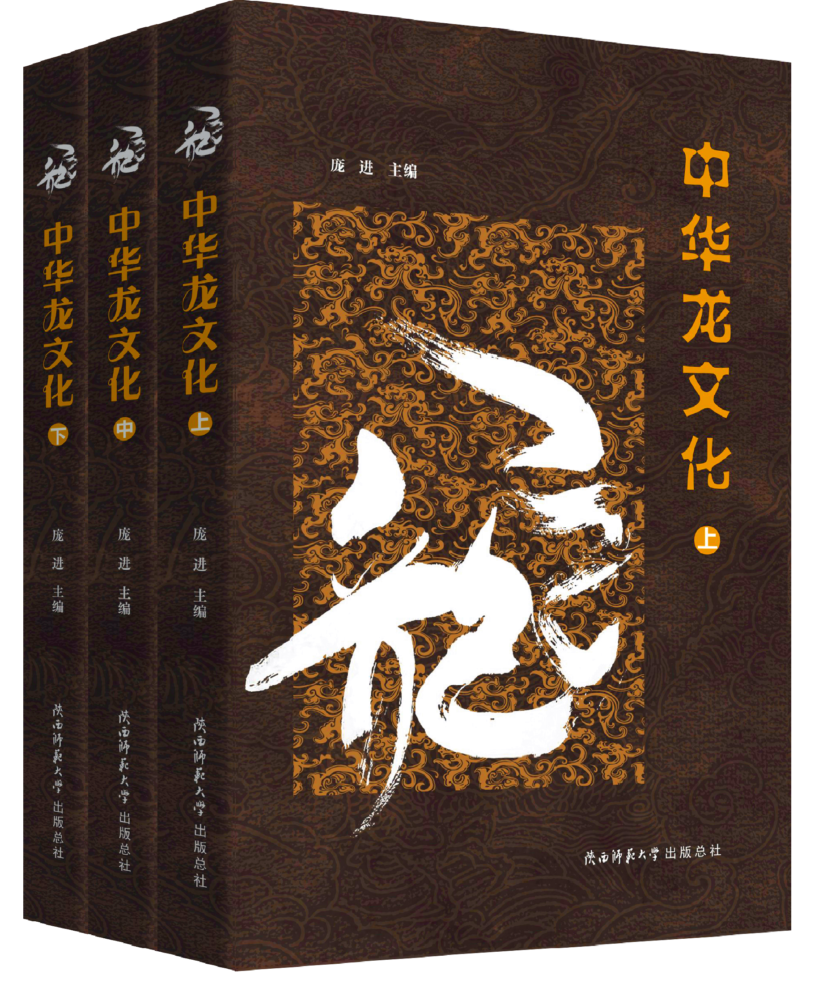
Author Biography: Pang Jin, writer, expert in Dragon and Phoenix culture research. Born in Lintong, Shaanxi in 1956. Chairman of the Dragon and Phoenix International Federation, Honorary Chairman of the Chinese Dragon Culture Association, Director of the Chinese Dragon and Phoenix Culture Research Center, Senior Editor at Xi'an Daily. Member of the China Writers Association, Director of the Shaanxi Provincial Writers Association, Special Researcher at the Shaanxi Provincial Academy of Social Sciences, Chief Editor of the Chinese Dragon and Phoenix Culture Network (www.loongfeng.org), Deputy Editor-in-Chief of Canada Xi'an Ontario Publishing House. Studied at Shaanxi Normal University and Northwest University, holding a Bachelor of Philosophy and a Master of Literature. Began engaging in literary creation and cultural research in the 1970s. Has published over ten million characters of various works, including fifty-one books such as “Theory of Creation,” "Chinese Dragon Culture," "Chinese Phoenix Culture," "Chinese Auspicious Beasts," "Pang Jin Collected Works" (Volumes 1-17), "The Wandering Sacred Tree," "Great Enlightenment of Lishan," "Qin Family Affairs," and "Dragon Love Phoenix Charm." Has won over eighty awards, including the first Chinese Bing Xin Prose Award, the first Shaanxi Folk Art Mountain Flower Award, and the first prize for outstanding achievements in social sciences in Xi'an. Known as one of the "Top Ten Contemporary Figures in Dragon Culture." Currently serving as a Director of the Association of Chinese Writers in Canada.


