Jiang Ni: A River in a Dream
Johnny
The Grand Canal stretches for thousands of miles, with several tributaries eventually flowing into the Hai River. The grain transport system invigorated the economy and led to the construction of cities. The place where I grew up has always been called a city brought by the canal. The river that floats in my dreams is the final stretch of the Hai River. Even though it's the end where the canal converges, several tributaries surround the land, making it look like a whale in a blue bay when viewed from above, hence its beautiful name, “Blue Whale Island.”
When I was little, I remember winters being especially cold. The entire river would freeze over with a thick layer of ice, and people could walk and even ride their bicycles on it without any problems. Back then, the favorite winter sport for young boys was ice skating.
Back then, ice skating was nothing like the ice sports we have today. Nowadays, ice skating uses very advanced ice skates, with blades for speed skating or figure skating; in short, it's very sophisticated. The ice contraption the boys played with then was called an “ice cart.” It was a wooden board about one square meter, with two steel bars nailed underneath to act as runners. The children would sit cross-legged on the ice cart, holding two steel bars with sharpened ends. With a push, the steel bars would dig into the ice, and the ice cart would glide away. It was a bit like skiing nowadays, except people sat cross-legged on the ice cart. The ice cart was stable and easy to operate, suitable for boys who weren't very agile. Its disadvantages were that it required a lot of effort and was slow.
Later, my parents“ company hired a group of employees from Northeast China. The children of these employees were very skilled at ice sports. The skating equipment used by children from the Northeast was very special, called ”single-legged donkeys.“ It consisted of two pieces of wood, the size of a pair of shoes, with the front lower than the back, forming a wooden trough. Beneath this was a sharp steel blade about thirty centimeters long. When skating, a person would place their feet in the wooden trough, squat on the wooden seat, and hold two long steel ice picks under their arms. This equipment was quite formidable; due to the small contact area with the ice and the long ice picks, it allowed for extremely high speeds. The drawback was that it required some skill, otherwise, it was easy to fall. At first, I used an ice sled, and later I tried to skate with the ”single-legged donkey" as well. After falling several times, I became a bit scared and went back to using the ice sled.
Children ice skating on the river in winter are a beautiful sight, with long lines of skaters winding and circling. Single-runner ice skates lead the way, followed by ice sleds, making for a very picturesque scene.
Summer on the Haihe River is the swimming season. Adults and children swim in groups. One inner tube can accommodate many people. The inner tubes are large, essentially inflatable tires. A disused barge is moored by the river, and many children climb onto its bow and jump off, calling it “popsicle.” Suddenly, shouts and cheers mix with the sound of “popsicles” falling into the water, making the entire area very lively. Since our whole family emigrated from the inland, we basically don't know how to swim. Seeing the lively scene by the water, I insisted on going into the water and jumping off the boat. It was a苦 for my mom. She sat by the riverbank all afternoon watching me swim, terrified of any accident, even though she herself couldn't swim at all; it was purely for her peace of mind.
Spring is the season when all things come back to life. I remember one year when a few of us elementary school students, carrying shovels and two people toting a bucket of water, went to plant trees by the river. Our group consisted of three elementary school students: two boys and one girl. We used shovels to dig a pit half a meter deep, placed the sapling inside, covered it with soil, and then watered it to complete the job. However, we still had to come back frequently to water it for the next few days, and the saplings usually survived quite easily. After being away from my hometown for twenty years, I finally had the chance to return. I specifically went to the riverbank to see the tree I planted. It was already quite thick and grew tall and straight. It turned out to be a poplar tree.
The most exhilarating season, of course, is autumn with its clear skies and crisp air. Back then, I loved sitting alone on the riverbank, basking in the sun, quietly watching the barges drift slowly by on the river. I wouldn't think of anything, just quietly watch for an entire afternoon. At that time, I always felt time passed too slowly, and I didn't know when I would grow up, nor what I would be like when I did. The future seemed hard to imagine.
After graduating from college, I was fortunate enough to stay and work in this city, so I could often stroll along this long riverbank again. The stretch of river near the train station has the best scenery. High-rise buildings stand tall on both banks, along with many colorful Western-style buildings with a distinctly European flair. The huge, old steel bridge is magnificent and imposing, and the half-man-high river levee is a great place for couples to date, lending a romantic atmosphere to this stretch of the river.
It was a time when China ended its long period of isolation, and a flood of Western culture poured into the country. Faced with this overwhelming cultural tide, young students, after a brief period of bewilderment, quickly began to absorb all sorts of cultural nutrients with an insatiable appetite, regardless of their quality. For a time, foreign language learning became a craze, with TOEFL and GRE preparatory classes springing up like mushrooms in universities and private institutions across the land. A massive wave of studying abroad swept across the newly revived land of China.
The 1990s were still a period of considerable resource scarcity, with generally low wages. Housing difficulties, in particular, had become a persistent problem affecting social development. It was common for young people reaching marriageable age to be unable to marry due to a lack of housing, and it was not uncommon for arguments to break out within work units over housing allocation.
At that time, I was also of marriageable age, but because I didn't have a house, my spouse and I had to live separately in our respective company dormitories. It became even more difficult after we had a child, so we had to leave our child with our grandparents, visiting them and our parents every weekend. At that time, it was still a single-day weekend system, meaning only Sunday was a day off each week. Every Saturday afternoon, after finishing work, I would rush to my parents' home, have dinner, and then have to rush back to work by the next afternoon. Our two-year-old child, however, was very sensitive. He would be overjoyed when reunited with us, but cry his heart out when we parted. These emotional rollercoasters of near-separation that happened every week were stimulating for the child and a significant trial for the adults. Although we were business backbones at our company and our careers were thriving, the hardship in our daily lives made us lose the courage and joy for pursuing higher-level goals. Housing had become an urgent problem that needed to be solved.
However, solving the housing problem is easier said than done! The only way to get a house is through the company's housing allocation. There are too many people competing for too few houses. The allocation is based on a points system according to years of service, and people like us who have studied for many years, are not young anymore but have short work histories, will definitely be at the back of the queue. Company housing allocation is basically a dead end for me. Both sets of our parents are from ordinary working-class families and have no means to pull strings. Solving the housing problem in China seems like an impossible goal.
At that time, the TV series "The Bund" was very popular on the mainland. Chow Yun-fat's handsome and dashing on-screen image immediately became adored by many young people. For a while, the white scarf Chow Yun-fat wore around his neck also became a fashion trend. Military overcoats, long mufflers, and bicycles became the standard for fashionable youths. My wife also knitted a long white muffler for me. I'd wrap it around my neck, and the ends would hang down to my knees. Wearing a military overcoat and riding a Flying Pigeon bicycle, it was quite a stylish ride, and I felt great.
On a late autumn evening, I, in a military overcoat and white scarf, and my wife, in a red thermal suit, embraced each other on the neon-lit riverbank. Looking at the brightly lit skyscrapers across the river, we couldn't help but feel a sense of sorrow and melancholy. We grew up here, we work and live here, yet this romantic river, shimmering with warm neon lights, seemed to not belong to us. An advertisement for an English training class, posted by someone on the riverbank, fluttered into view and then, lifted by the cold wind, flew off and landed in the rippling river, drifting into the distance. A voice kept echoing in my ear, “Go abroad!” Finally, a bold decision was made on this cold yet warm winter night: we were going to go abroad. Once the resolve to leave was made, even the surging river seemed to murmur softly, as if we heard a blessing from heaven.
The main way to apply to study abroad back then was to send out letters. Once you received an invitation, you could apply for a visa and go abroad. Each airmail letter cost a little over five yuan, which might not seem like much, but for us, wage earners whose basic salary was only a little over a hundred yuan, it was still a considerable expense. When my wife and I, carrying an old-fashioned briefcase and a bag full of airmail letters, spread them out on the post office counter to affix stamps, people thought we were sending out official correspondence.
After more than a year of persistent effort, I have finally received an invitation from KU Leuven in Belgium to be a visiting scholar. However, due to certain conditions in the professor's invitation letter, I am forced to face the issue of delaying my visa for several months.
Despite the uncertain future, despite never having been to Europe, and despite having no knowledge of foreign countries at all, I still boarded the plane to Brussels without hesitation, because it was the only way to solve our current difficult situation.
The outside world is wonderful, but after the fleeting excitement of going abroad, a huge cultural shock in terms of thoughts, language, and environment follows, along with endless loneliness far from loved ones. Meanwhile, the difficulty of obtaining a visa leaves me feeling lost about the future. This feeling of loss and confusion is something that cannot be experienced domestically, because in China, we never face identity issues; our Chinese national identity is inherent. However, abroad, we must prove the legality of our identity with various documents and obtain further legal residency in a foreign country. This process is painful and very frustrating.
Once, the school organized a weekend trip to Germany, and being bored, I also got on the bus to Germany. When we stopped by the Rhine River not far from Aachen, I almost lost control of my emotions.
It was a gently flowing stretch of river, with many tall gantry cranes and factory buildings in the industrial zone across the way. On this side of the river were residential buildings of medium height. A rusty barge floated in the river, strongly resembling the Hai River where I played as a child.
I stand on the banks of the Rhine. Looking at the boats, the cranes, the buildings, it's as if I see my childhood self playing by the river, swimming in it, planting trees on its banks. Now, my elderly parents, my young wife, my tender young son, their expectant and bewildered eyes gaze at me incessantly from the shimmering water of the slowly flowing Rhine. I feel an indescribable sense of helplessness. Unconsciously, my vision blurs, and my cheeks become wet.
After more than a decade of drifting and arduous survival, life has finally become basically stable. Interestingly, whether it's fate's arrangement or not, every place I've ever worked and lived always had a river, leaving me unforgettable memories.
I lived in Leuven, a beautiful university town in Europe, for almost four years. A winding river in town, much like a miniature version of the river in my hometown, gave me a distinct sense of home. In 2008, due to changes in my work, I had a period of working in New York. At that time, my son was already in high school, and every weekend, we would drive him to a small town in New Jersey to a drum shop to learn to play the drums. That small town was by the Hudson River. One autumn weekend, we first dropped our son off at the drum shop, and then walked along the Hudson River to pass the time. As we reached a bend at the foot of a mountain, we saw that the river was calm and wide. Not far away, we could see the majestic George Washington Bridge and a cluster of tall buildings on the opposite bank. A cargo ship was slowly passing by on the river.
I stood there quietly for a long time, unable to take another step. Looking at the scene before me, the river of my hometown drifted into my vision without my even realizing it. A young boy sat on the riverbank, looking blankly at a cargo ship, wondering when he would grow up. The magnificent Liberation Bridge lay before me, and on that stretch of the riverbank, a couple embraced. Their military coats, long white scarves, and bright red winter clothes cast a scattered light on the river. What drifted before my eyes was my hometown, a place where I had lost my youthful days. An indescribable melancholy welled up in my heart. It wasn't until the cargo ship sounded its long horn that I realized I was in a distant land, and my hometown was already a little blurry in my dreams.
Time flies, and before I knew it, I had been living in a foreign land for over twenty years. I finally settled in the beautiful Maple Leaf Country. I still prefer living near water, so I bought a house not far from Lake Ontario, so that I could sit by the water from time to time and think about the river in my hometown and the many unforgettable stories associated with it. I can't truly go back to my hometown anymore. The hometown of today has changed so much that it no longer resembles the place of my childhood. Photos sent by friends show that a huge cable-stayed bridge has been built over the river in my hometown, with so many tall buildings on both banks that they are nothing like what I remember. It's said that a riverbed tunnel will soon begin construction, making transportation unimaginably convenient. The hometown in my dreams is no longer what it was in my memory.
So I like to sit quietly by Lake Ontario, watching the clouds on the horizon, the seabirds flying in the sky, the boats floating on the lake. In my mind, I see my hometown from my dreams: the winding river, the rusted barges, the tall poplar trees by the river, and the Liberation Bridge reflecting the neon lights. In my dreams, I return to my hometown!
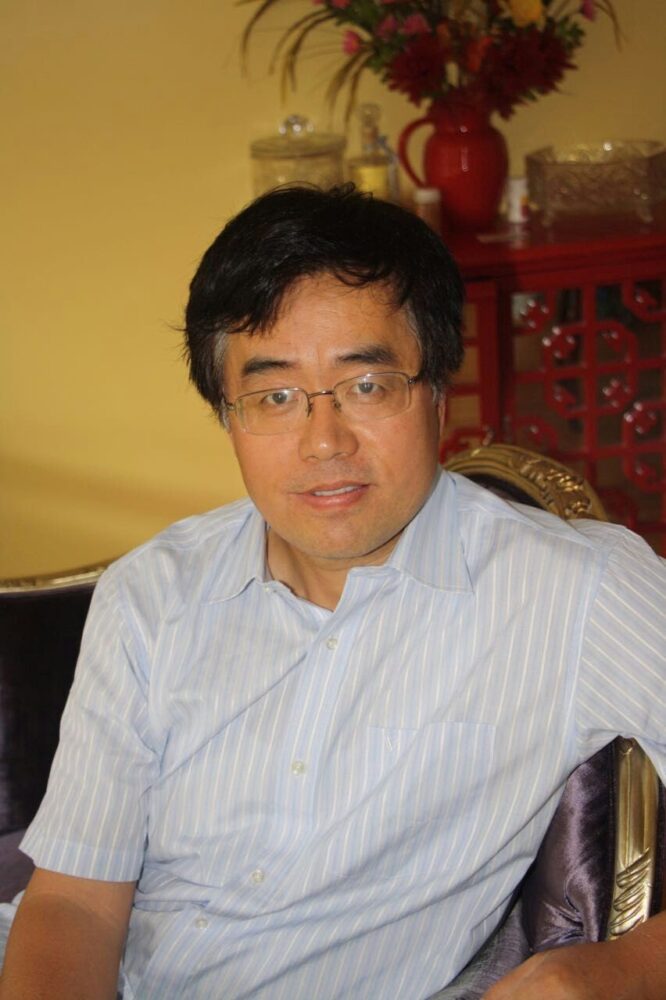
Author's Biography: Jiang Ni, a member of the Canadian Chinese Writers Association. A Canadian citizen of Chinese descent, he was a university student in the 1980s, graduating from a domestic medical school with an eight-year program and a Ph.D. in Medicine. A former cardiovascular physician, he traveled through Europe and now resides in Canada. He has engaged in cardiovascular basic research at renowned research institutions in Europe, Canada, and the United States. Having a lifelong passion for literature since childhood, he began creative writing in recent years. He is the author of the autobiographical documentary novel "Physician's Diary," essay collections "Feelings for the Maple Country" and "The Autumn Wind Rises," and personal poetry collections "Love in Toronto" and "Four Seasons in a Foreign Land." His poems, essays, and novels have been published in various newspapers, magazines, and anthologies. A large number of his blog posts are featured on the "Overseas Literary Pavilion" website.