
Make the novel more engaging — Preface to "Beauty's Twilight"
Lu Xiaohua
I'm a self-taught novelist and I disdain attending creative writing workshops at literature departments or majoring in Chinese literature. I think those are just assembly line techniques for producing stories, like they're all cast from the same mold, or rather, taught by the same teacher! As for writers, my understanding is that they should be like independent craftspeople or individual artists; each one should have their own unique approach. As the saying goes, everyone can perform magic, but each has their own subtle differences! My writing relies on nothing more than reading the works of masters from ancient and modern times, both Chinese and foreign, and my own personal enlightenment. To date, including this one, "A Beauty's Twilight," I have published three collections of short stories—the other two are the short story collection "A Tuo Morning Rain" and the micro-fiction collection "The Three Dimensions of Life." I have also published hundreds of thousands of words of fiction in newspapers and periodicals. Regarding novel writing, throughout my journey, I have also developed a set of my own unique ideas and methods.
Novels are naturally written for readers to read. This brings up the question of what kind of novels readers are willing to read. Novelists must try to capture readers' attention, but readers are a diverse group, and you cannot and should not try to please everyone. Therefore, before writing, you must consider the intended audience for your work. To put it plainly, who do you want to read what you write? Will you choose a popular route, an art literature route, or a compromise?
When it comes to reading novels, a friend once told me that reading novels isn't like taking traditional Chinese medicine. Why do novels have to be so obscure and difficult to read? He was referring to the fact that many contemporary literary and avant-garde novels published in reputable journals are not very engaging, which leads to their low circulation. I think this is a very reasonable point. On the other hand, the novels popular on the market and online, which are dominated by themes of sex, secrets, time travel, murder, officialdom, tomb raiding, and so on, although they have a large market, are too vulgar. They don't align with my literary aesthetic principles. Therefore, I've been pondering how pure literary novels can find a middle ground between these two extremes.
My literary writing mainly adopts a realist approach. My personal pursuit in fiction is to be interesting, tasteful, and culturally profound. My literary philosophy has always been: the highest realm of literature is appreciated by both the refined and the common! My literary writing pursues exactly this perspective. Furthermore, I strive to write in a way that is close to real life. I believe that in this kaleidoscopic era of change, the southern region of Hainan, individual lives, family destinies, the lives, destinies, humanity, and emotional stories of people around me, etc., are inexhaustible sources of my creation.
I have many years of experience editing literary journals. I have published numerous short stories under my own name or anonymously in journals I have edited, as well as many online. My intention in doing so was to use these platforms as a testing ground to verify the readability of my stories. Based on feedback from many readers who have read my stories, the general consensus is—reading your stories is not tiring. That alone is enough! Perhaps this is the effect I was looking for and the path I was seeking.
I don't want to take on too much responsibility for my novels, nor do I want them to have too much of an educational function. I will certainly not use novels as a tool for singing praises. My writing bottom line is to speak humanly for the common people, not to sing praises for emperors. My idea is that a novel is like a mirror, reflecting the times and real life, depicting life, human nature, and human destiny. It is enough for readers to see the life of their times and regions, and even their own shadows, after reading it with ease. Of course, this does not mean that I do not pay attention to the cultural and ideological content of the novel. Sometimes, I consciously or unconsciously incorporate my own thoughts. After all, elegant literature pursues truth, goodness, and beauty, and exhorting people to do good is its inherent meaning. A higher requirement is to enlighten the populace. This is also the reason why society should support elegant literature.
Good novels, especially those with a refined cultural taste, need to be composed of many elements. To find and organize these elements, and thus write a good novel, requires solid foundational skills. These skills include good literary expression, a good story, good editing, good imagery, and so on. Having good foundational skills is a talent. Rich knowledge, interesting stories, vivid characters from life, lively and engaging language, distinct personalities, and of course, the work must have a certain intellectual and cultural depth. To achieve all of this, you need an interesting soul.
Some foundations of literature, such as knowledge structures, rely on long-term cultural accumulation; other foundations, such as shaping an interesting soul, require good self-cultivation to achieve. As for literary language, in pursuit of flavor, vividness, and variation in novelistic language, I have spent a great deal of time, for instance, reading the works of master predecessors in various styles, and in my youth, I even spent a lot of time doing arduous writing exercises.
I remember exchanging emails with a famous writer once. I sent him a collection of my short stories (one of which was titled "Played with Fire"). After reading them, he replied, "You're a bit vulgar!" I couldn't help but laugh. I knew that this particular story must have been the dividing line between elegance and vulgarity in his eyes. It turns out that when he was the editor of "Tian Ya" magazine, the publication was always considered a beacon of highbrow literature in China. I respect that magazine, and I have honestly submitted manuscripts according to its standards. Years ago, I published a short story titled "My Classmate Bian Lisa" in that magazine, and later another short story, "Migratory Bird Apartments." So, by publishing in that magazine, I wanted to test whether my works could meet their standards of elegance. The underlying pursuit was nothing more than to find a boundary point where both elegant and common tastes could be satisfied.
My novel writing is closely tied to life. Life has given me so many inspirations. Life has also provided me with too many wonderful stories. I am grateful for life, and I often marvel that in this era of change, social life is so rich and colorful. In fact, it can be said that real events that happen in life are often more exciting than painstakingly fabricated novels. For example, the male official who had over a hundred mistresses, or the female official who spent tens of thousands of yuan to fix her buttocks. I think, since social life is so abundant, why can't literary fiction writers use the material provided by this era of change and social life to make their novels more appealing, thereby achieving the self-salvation of literary fiction?
The text above is the preface to this collection of short stories!
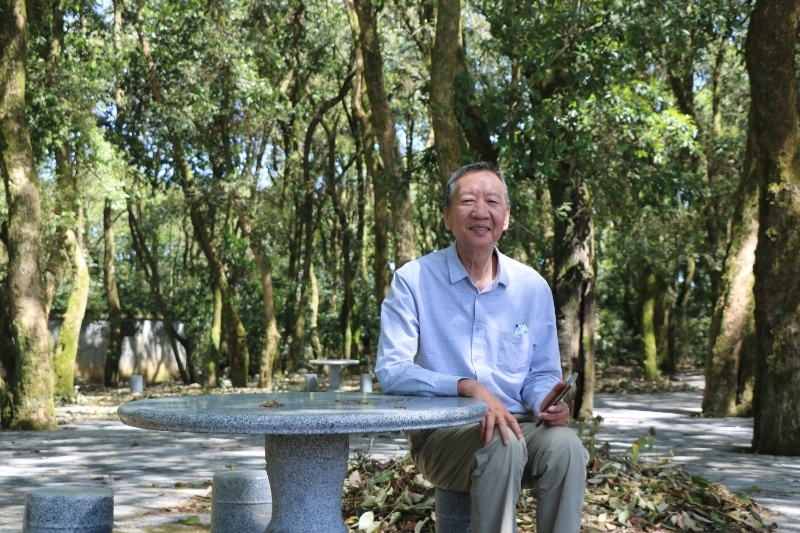
Lu Xiaohua Biography: Lu Xiaohua is a novelist, male, from Sanya City, Hainan Province. Born in 1954 (Year of the Horse) in a place called “Yanglan” (now Fenghuang Town) in the former Yai County, Hainan Province. Therefore, he often self-deprecatingly jokes that a "thousand-mile* horse cannot run out of a sheep pen." His life has been content with a corner of the world. Although he has not traveled far, he has engaged in various professions and possesses a rich life experience worth writing about.
*A thousand-mile horse is a metaphor for extraordinary talent.
In 1985, they studied creative writing in literature. They have published approximately one million words of novels, essays, and reportage in domestic periodicals and magazines such as "Tianya," "Short Story," "Essay Hundred Schools," "Foshan Literature and Art," and "Green Oasis." Their published works include the novella "A Duo's Morning Rain" (Guangming Daily Publishing House); the micro-fiction collection "The Three Dimensions of Life" (New York Publishing House, USA); the novella and short story collection "A Beauty's Twilight Years" (Ningxia People's Publishing House); and the essay collection "A Square Sky on the Balcony" (China Overseas Chinese Publishing House).
In 1997, she served as an editor for the magazine "Sanya Literature and Art" of the Sanya Federation of Literary and Art Circles, editing a total of 5 issues. In 2010, at the invitation of the Sanya Museum of Art, she edited fourteen issues of "Sanya Literature and Art." Later, she became the chief editor of the folk literature magazine "Sanya Bay," which has now published eighteen issues. She currently works as a freelance writer and chief editor of a folk publication.
Its artistic pursuit in novel writing is to be appealing to both highbrow and lowbrow tastes, be enjoyable to read, and possess cultural refinement.


