A scroll of poetry sings of beauty, half a lifetime of ink writes legend.
— A Critical Appreciation of Yan Daxia's Classical Poetry "Literary World's Jade — Qiong Yao's Farewell" and His Trilogy of Women
Author: Luo Jing
On the anniversary of the passing of the renowned writer and literary giant Qiong Yao, who is highly recognized on both sides of the Taiwan Strait, her former classmate, the great swordsman Yan Da Xia (Yan Fei), following the style of Bai Juyi's "Song of Everlasting Sorrow" and inspired by the "Song of Burying Flowers" from "Dream of the Red Chamber," has penned "Literary World's Qiong Yao Ci" to mourn the soul of Aunt Qiong Yao.
Brother Yan and I both grew up reading Qiong Yao novels and watching Qiong Yao dramas. The love and hate depicted in Qiong Yao's works accompanied us through our youth. Whenever I hum “A girl named Wan Jun, her story is worth pursuing, a little bride, destined for three lifetimes. A momentary dream, eternal sorrow...”, Ms. Qiong Yao's gentle figure appears before my eyes. She is the dream weaver of countless people's youth.
My classmate, the great hero Yan, is also a fan. Although he couldn't meet Qiong Yao in person in Taiwan, he finally got through on the phone. He eagerly talked about the works that had long since merged into his blood: the confusion of “Outside the Window,” the entanglements of “Rainy Mists,” the vicissitudes of "How Many Sunsets Red..." This phone call seemed like a literary pledge he was sending across the strait. On the other end of the line, Qiong Yao said softly, "Take your time, Yan Fei, I'm listening." Her voice was not sharp, but like a stream in early spring, breaking the ice, clear, warm, and reaching the bottom of the heart. Unintentionally, the great hero and Qiong Yao, in a duet of male and female voices, sang together, "Green grass, vast white mist, a fair lady, on the water's edge..."
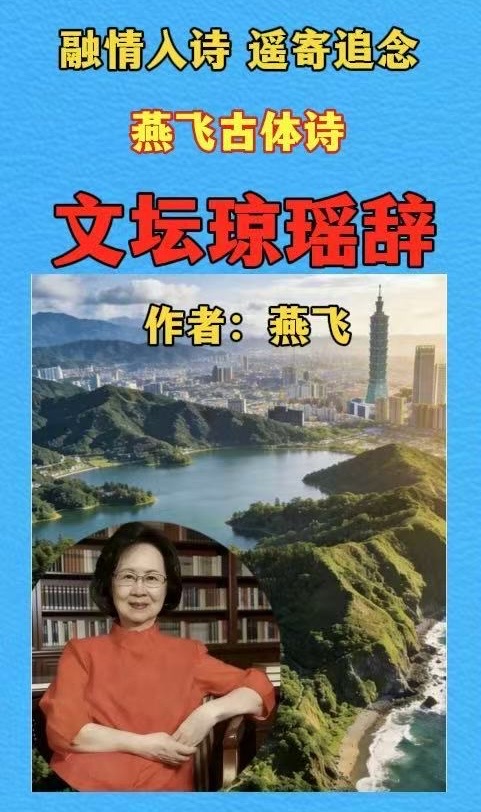
"Literary World Qiong Yao Ci" Poster Cover (Designed by Axin)
On the occasion of the one-year anniversary of the passing of literary legend Chiung Yao, the esteemed Master Yan has poured his heart into composing "A Farewell to Chiung Yao of the Literary World." This poem serves as a heartfelt tribute, its every word imbued with emotion, its style profound, subtle, and deeply resonant, its sentiment lingering and rich. Within its rhythmic cadences, it beautifully expresses the earnest emotions from that time when he journeyed across the sea to Taiwan and sought tutelage at her door, while also concealing boundless reverence for the enduring spirit of the Master. The poem not only conveys deep remembrance for a prominent figure of that literary era, blending emotion with imagery and intertwining thoughts with longing, where each line paints a scene and each word evokes a feeling, it showcases the integrity of the writing and, more importantly, a pure and devoted heart, making it a masterpiece of remembrance.
Amidst clouds adorned with vibrant hues, returning from the radiant sky, I seek a mentor in the literary world, searching for a pure, guiding light.
Jade melodies pierce the clouds, Suddenly, I feel the spring breeze accompanying the swallows.
This morning, a lifetime ago, I remember, at the turn of the century, flying to Taipei.
Countless memories flow away like water, only the songs linger around the green peaks.
Born in Hengyang, Hunan province, Qiong Yao hails from a distinguished scholarly family, steeped in the refined elegance of the Xiang culture from childhood. She absorbed the profound nourishment of Chu land's humanities, inherently possessing the talent and sincerity of a woman from the Xiao and Xiang regions. Born on the banks of the Jialing River, her youth coincided with times of upheaval. She moved with her parents, experiencing the vicissitudes of life and migration in Chongqing and Shanghai before settling in Taiwan in 1949. Her life, marked by half a century of wandering, her deep yearning for her homeland, and her profound understanding of the sentiment across the Taiwan Strait, all transformed into enduring creative nourishment for her writing. This provided her with an unparalleled deep foundation for her later works that vividly depicted the folk customs of the mainland, imbuing her stories with both patriotic sentiment and tender affection that resonated deeply with readers. The poet's concise lines, rendered with powerful strokes, masterfully capture Qiong Yao's dramatic yet brilliant life in just a few seven-character verses, each word resounding, each phrase vivid.
Born in literature by the Jialing River, renowned on both sides of the strait.
My brush can summon rain from three mountains, my scroll can shield from the sun of five peaks.
The Isle of Taiwan's misty glow arises from within the wrist, the clouds and waters of Xiaoxiang unfurl like a rainbow.
Sixty springs have studied the ice dew, and a hundred works of pearls adorn the brocade screen.
Qiong Yao's prolific literary output spans decades, with countless classic masterpieces flowing from her pen. Her words are steeped in tenderness, and each piece showcases her exquisite style. The passionate love, lingering affections, and deep emotional entanglements she depicts have painted a picture of pure and intense love for a generation, making her many enduring works household names that have become literary symbols etched in collective memory. With ingenious craftsmanship, Yan, the master poet, uses poetry as a vehicle to effortlessly weave her widely acclaimed classics into verse. Each line precisely captures the essence of a timeless masterpiece, seamlessly integrated, with a rhythmic ebb and flow that seems to unfurl a magnificent and grand literary history of Qiong Yao's works. The vivid stories, touching emotions, and classic scenes leap off the page, evoking a familiar warmth and melancholy that lingers long after reading.
Parting and gathering leave a thousand knots in the heart; Suddenly, a cuckoo's call is heard outside the window.
Misty rain fills the sky and clouds, a deep courtyard shrouded in mist.
The plum blossoms by the water, the colorful clouds easily scatter, the pearl dream returns.
Several sunsets dyed red, a curtain of dreams chasing butterfly shadows.
Qiong Yao's literary charm extends far beyond the pages of her books. Her works are veritable star-making factories for film and television, igniting their own brilliance from the very beginning of their adaptation onto the silver screen. The stories she penned possess inherent dramatic tension and emotional resonance, transforming into blockbuster masterpieces once brought to life on screen. Furthermore, with her unique casting eye and compelling narrative core, she has discovered and honed a vast array of shining actors for the Chinese film industry, propelling generations of cinematic superstars and classic screen faces to fame. These individuals rose to prominence and gained recognition through Qiong Yao's works, and in turn, breathed eternal life into them with their vivid performances. They achieved success together, shining brightly, forging an unrepeatable, glorious legend in the history of Chinese film and television. "Yan Daxia" deeply understands this splendor and praises this magnificent scene extensively in his poetry. His writing is unrestrained and his words are sincere, eloquently narrating this glory of light and shadow and the legend of star-making, revealing his utmost admiration with every read:
The film and television industry shines like a bright star factory, the silver screen's brilliance illuminates the grand hall.
There's also the beauty of a cloudy moon chasing clouds, and the sorrow of love in the Qin and Han dynasties.
There are also virtues and elegance that bring tears to the eyes, and there is also the brilliance of snow that shines brightly.
There have been several "Little Swallows," all nurtured and grown under the grace of Chiung Yao.
The sudden passing of Qiong Yao is an irreparable and profound loss to the Chinese literary world, and a dimming of the literary constellations. A literary giant has departed, and the world will no longer have that legendary talent who, with a soft brush, wrote of the joys and sorrows of human love, and with a sincere heart, spread across the world the entanglements of love and hate. The myriad tenderness and thousand kinds of elegance in her writings have become an eternal swan song in the years, leaving behind only endless remembrance and regret for the world. Hero Yan, looking up at the sky, remembering the professor's enduring spirit and immortal literary soul, poured his heart into his pen and sighed with emotion, composing an eternal lament: “The mists and clouds beneath the brush will never dissipate, forever circling Kunlun for a thousand autumns and ten thousand generations.” Every word carries the regret of reluctance, and every sentence hides the sincerity of admiration. At the end of the poem, he further, with a surging heroic spirit, penned a soul-stirring, legendary ode. Every word resounds, and every phrase is grand and imposing, inscribing the most magnificent closure for this legendary female writer who spanned generations. Honoring her literary fame, praising her spirit, and celebrating her immortality, he etched this deep remembrance and highest praise into the long river of time, resonating through the constellations of literature:
Do you not see?
In the ocean of literature, we ferry souls lost in passion, Gathering spirit and grace, we knock on heaven's gate.
A thousand veils of tears soak a thousand autumn rains, ten thousand scrolls of souls vanish, heard through ten thousand ages.
The smoke and mist beneath the brush will never dissipate, Circling Kunlun for a thousand autumns and ten thousand generations.
A talented woman recorded in history; who in the world doesn't know you!
Yan Da Xia, whose real name is Yan Fei, uses the pen name Yan Fei. He founded the martial arts association at Changsha Communications University (now Changsha University of Science and Technology), proudly declaring himself a descendant of martial arts heroes and calling himself Yan Da Xia (Grand Hero Yan). Originally a student of road and bridge engineering, Grand Hero Yan once worked for People's Communications Publishing House. In the early 1990s, he moved south to Haikou in “Coconut City” and became a professional writer. When it comes to contemporary poets and writers who specialize in female themes and have extensive works, Yan Da Xia is a unique and undisputed figure. He uses poetry as a boat, filled with admiration and deep affection for women, carving out a brilliant world exclusively for women in the literary realm. His magnum opus has been published in top domestic literary magazines such as "Chinese Writers," "People's Literature," "Tianyá," and "October." His works have achieved great success, winning provincial and ministerial-level awards multiple times. Grand Hero Yan's journey into exclusively writing about women, a "land of daughters," began in the early 1990s. He subsequently wrote several specialized works with female themes, including "Hainan Without Dreams," "Hainan's Startling Dream," and "Hainan in Search of a Dream." His full-length novel, "Tribulation: A Woman's Glory and Shame," was an immediate sensation, causing a stir and going through multiple printings. It is still occasionally available at major Xinhua bookstores today.
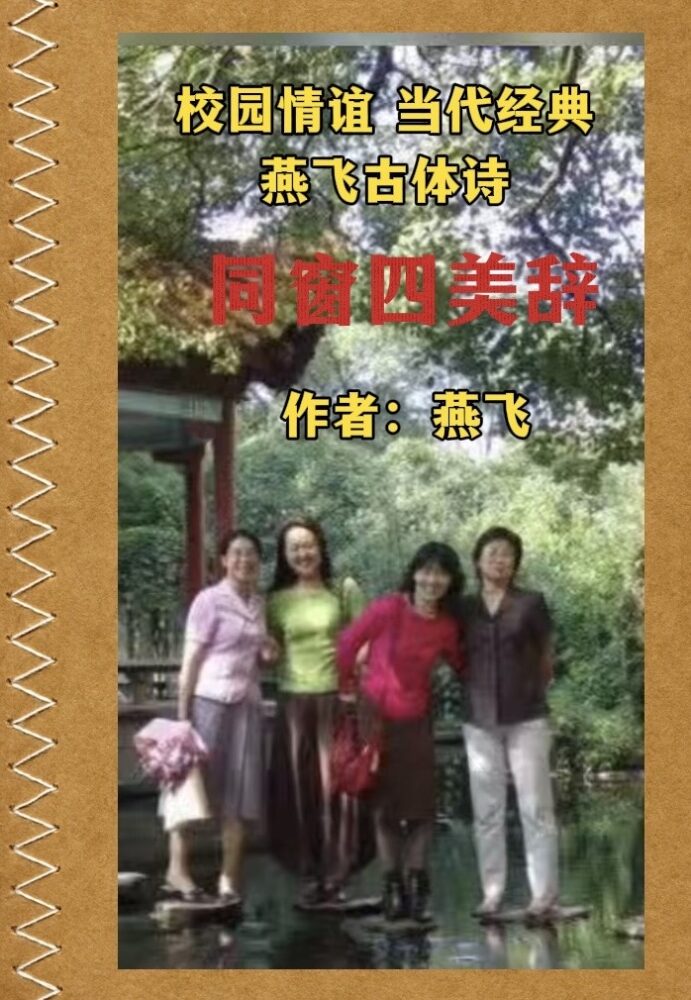
After moving to North America, Swallow Hero continued to cultivate his work in the land of women. “Ode to Four Beautiful Classmates” laments four beautiful and charming female classmates from university. On the occasion of their thirtieth graduation anniversary, Swallow Hero flew across the ocean to the south to reunite with his former classmates. The reunion, after a long separation, brought back memories of youthful times, stirring Swallow Hero's emotions. Thus, under the theme of “Four Beauties,” he penned "Ode to Four Beautiful Classmates." Today, each of the "Four Beauties" is a successful wife and mother, living vibrant lives. Zeng Wanzi, a writer from Hainan and a member of the Chinese Writers Association, once praised Swallow Hero's "Ode to Four Beautiful Classmates" in "A New Melody of Classmate Affection." I, too, in the capacity of a witness to our shared classmate experience, published an appraisal of Swallow Hero's "Ode to Four Beautiful Classmates," titled "A New Melody Sent to Classmates, Sharing the Same Bright Moon Under the Heavens," focusing on its cultural memory and reflection of the times, on "Writers China."
"Red Chamber's Farewell to Xiaoxu" is the swan song of Great Hero Yan, written to commemorate the ill-fated beauty Chen Xiaoxu. The poem begins with Great Hero Yan coincidentally encountering the CCTV "Dream of the Red Chamber" cast during their tour in Qiongzhou. It recounts their journey from acquaintance to deep understanding, their correspondence like geese in flight, and a destined reunion as reincarnated souls of Boya and Ziqi. Later, Xiaoxu left her marriage, ventured into the business world, but faced repeated setbacks. Ultimately, she saw through the vanities of the world and became a nun. Meanwhile, Great Hero Yan traveled to North America. Despite the vast distance, his devoted heart remained close. His soulmate contracted breast cancer and passed away peacefully at a Taoist temple in Shenzhen. A peerless beauty, her memory will live on for generations, though her earthly fragrance has faded. Great Hero Yan's "Red Chamber's Farewell to Xiaoxu" is written with tears of blood in every word and sorrow in every line, reading it breaks one's heart.
Xiǎo Xù rides a crane to heaven, Billions of fans weep their hearts out.
A great hero sighs deeply abroad; for years, sorrow has been unforgettable!
The most heart-wrenching part of “Red Mansions and the Farewell of Xiaoxu” lies in its dialogues that transcend time and space. The epiphany, “With Chen Xiaoxu in the heavens, Lin Daiyu's soul will never again exist on Earth,” and the anticipation of "If the Story of the Stone were to be continued in later years," ultimately elevate this bond into an eternal proposition.
From “A Farewell to My Classmates,” to "Red Chamber Dawn," and most recently "Literary World Qiong Yao," these three poems are a legendary "Trilogy of Poetic Women" by Yan Fei. Today, these three ancient-style poems have been published on various platforms such as the "Writers' Network" and have repeatedly become staple performances at major North American Chinese gatherings and the Hainan Writers Association's annual galas. Renowned writers and performers have collaborated on multiple occasions to bring them to life.
Women are the eternal protagonists in Yan Da Xia's writings, and the brightest light in his heart. From the verdant campus to today, despite the vicissitudes of life, his admiration and love for women have remained unchanged, like the rising sun, fervent and pure. In the years to come, I firmly believe that Yan Da Xia will continue to pick up his pen and write more moving chapters about the “kingdom of women.” And I will wait patiently.
Author Biography:
Luo Jing, Professor. Vice Chairman and Legal Representative of the Guangxi Highway Society. Graduated from Changsha Communications Institute with a major in highways and bridges. Former Professor at the School of Highways and Bridges, Guangxi Communications Vocational and Technical College, full-time highway and bridge teacher, member of the China National Democratic Construction Association. Long-term involvement in teaching and scientific research in highways and bridges, pioneered rap-style professional courses. Participated in 6 provincial and ministerial level scientific research projects, authored 3 local standards and 1 group standard. Won the Second and Third Prize for Outstanding Scientific and Technological Achievements from the National Archives Administration, the Second Prize for Social Sciences from the People's Government of the Autonomous Region, and the Third Prize for Scientific and Technological Progress from the Autonomous Region twice. Holds 6 intellectual property rights. Has published 4 academic monographs. Has published over 40 papers in professional journals, including Chinese core journals. Enjoys literature, occasionally creating poetry and prose when inspired.